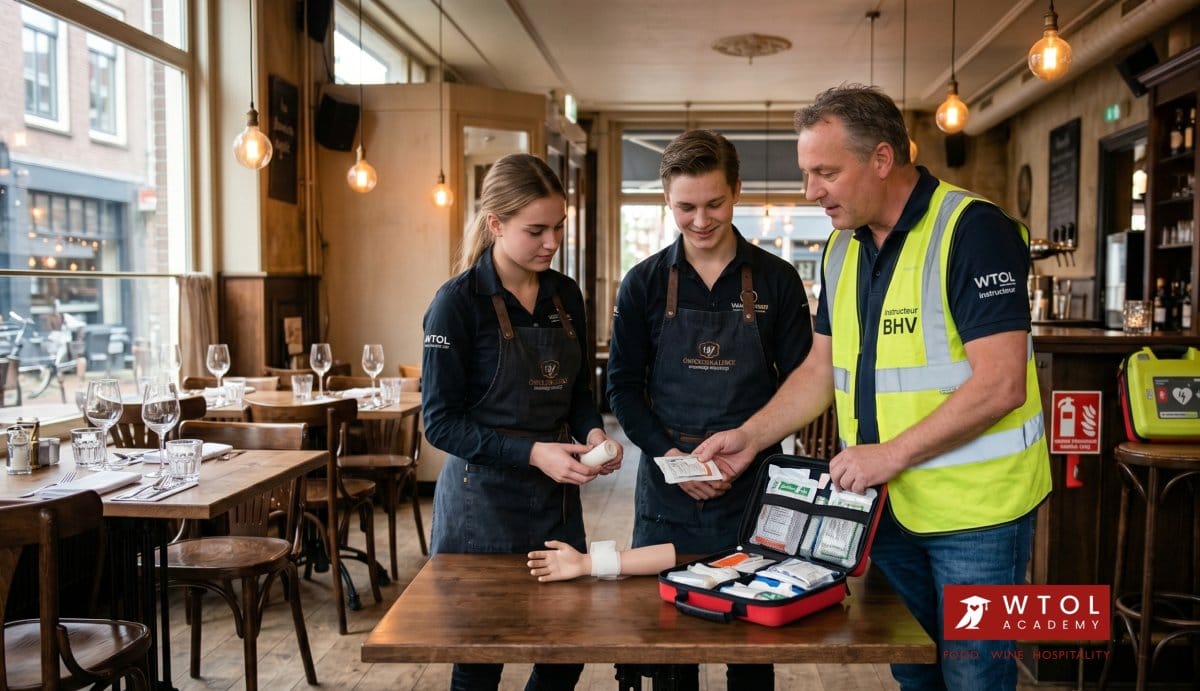


Did you know that over five percent of hospitality employees experience a workplace accident annually? You’ll probably recognise it: the mandatory emergency response officer hospitality refresher course often feels like a time-consuming repetition that has little to do with the reality of a busy Saturday night. It’s difficult to roster employees off for training that focuses on office environments, whilst the risks in your establishment lie with the deep fryer, on slippery floors, or in a crowded room.
We understand that safety and hospitality must go hand in hand without jeopardising your staffing levels. In this guide, you’ll discover how to efficiently comply with the stricter controls of the Dutch Labour Inspectorate and the Working Conditions Act in 2026, without losing focus on your guests. We discuss how a modern approach with e-learning and practical scenarios ensures quick certification that truly adds value to your team’s competence. You’ll learn how to guarantee the highest standard of safety for both your team and your guests with minimal impact on the schedule.
Key Points
- Learn why an annual emergency response officer hospitality refresher course is essential for performing life-saving actions and fire fighting on autopilot.
- Discover how blended learning allows you to complete the theory flexibly online, minimising the impact on work rotas and staffing.
- Gain insight into the current requirements of the Working Conditions Act and learn how to precisely calculate how many certified employees must be present in your establishment at all times.
- Understand the importance of practical training specifically tailored to hospitality scenarios instead of general office environments.
- Discover how SVH-accredited training ensures a professional safety standard that seamlessly aligns with the hospitality of your business.
Table of Contents
Why an Emergency Response Officer Refresher Course for Hospitality is Essential for Your Business
The Content of an Effective Emergency Response Officer Refresher Course for Hospitality
Legal Frameworks and the Working Conditions Act in the Netherlands
Why Choose an Emergency Response Officer Refresher Course for Hospitality at WTOL Academy
Why an Emergency Response Officer Refresher Course for Hospitality is Essential for Your Business
In a bustling hospitality business, everything revolves around experience, but behind the scenes, safety is the invisible engine. An emergency response officer hospitality refresher course is much more than an annual obligation; it’s an essential refresher that ensures your team is sharp when it truly matters. Whether it’s a small fire in the kitchen or a guest feeling unwell, adequate action makes the difference between a minor incident and a major catastrophe. Knowledge of resuscitation and fire fighting is unfortunately not static. Without regular training, routine fades, causing employees to freeze or make mistakes at critical moments.
By investing in this annual training, you safeguard the continuity of your business. Company emergency response (BHV) forms the basis of your risk management. A trained team limits damage during incidents, keeping the impact on your business operations minimal. Moreover, a team that knows exactly what to do exudes calm and professionalism, directly contributing to a sense of safety for your guests.
The annual obligation and the validity of your certificate
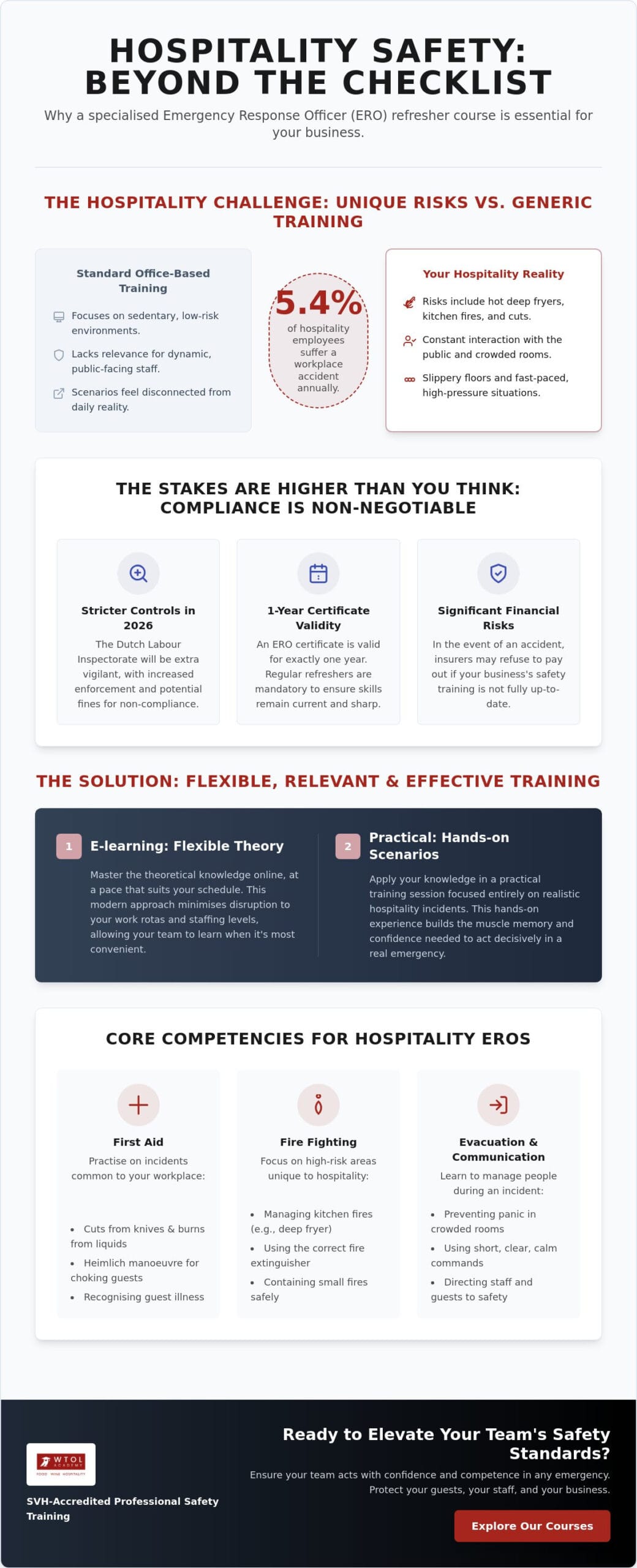
An Emergency Response Officer certificate has a limited validity of exactly one year. This is not without reason; the legislator and insurers require that current knowledge remains up-to-date. If you let the validity expire, you run significant risks. In the event of an accident, the insurance company may decide not to pay out if it turns out that safety measures were not in order. Maintaining an up-to-date safety register is therefore a must for every entrepreneur who takes their profession seriously. Timely scheduling of a refresher course prevents fines from the Dutch Labour Inspectorate, which will be extra vigilant in 2026 regarding the presence of certified personnel.
Safety as part of your hospitality concept
True hospitality means that a guest can confidently entrust themselves to your care. Safety is the invisible foundation of every good dinner or pleasant evening out. When something goes wrong, a confident Emergency Response Officer is worth their weight in gold. By acting calmly and decisively, you prevent panic in the establishment and maintain control of the situation. This strengthens your professional image; guests remember not only the incident but, more importantly, how skilfully your team resolved it. For those who want to elevate their team to a higher level, WTOL Academy’s courses offer the perfect connection to the daily practice of the hospitality floor.
The Content of an Effective Emergency Response Officer Refresher Course for Hospitality
A standard safety training often feels like a distant concept for many hospitality professionals. An effective emergency response officer hospitality refresher course breaks with that tradition by directly linking theory to the dynamics of your business. The three familiar pillars; first aid, fire fighting, and evacuation, are given a practical interpretation that you’ll immediately recognise from the workplace. It’s not about dry textbook material, but about scenarios that play out between the tables, behind the bar, or in the heat of the kitchen. Precisely this realistic approach ensures that knowledge sticks and your team acts with confidence when it truly matters.
In addition to basic techniques, there is significant attention to communication. In a crowded restaurant, panic is your greatest enemy. You’ll learn how to use short, clear commands to both direct your staff and calm your guests. You’ll also receive a crucial update on the latest guidelines for resuscitation and the use of an AED. Because techniques and protocols change regularly, this annual refresher is indispensable to remain competent.
First aid for hospitality-specific incidents
In 2025, 5.4 percent of hospitality employees experienced a workplace accident, according to figures from the CBS. These often involve cuts from a slipping knife or burns from hot liquids. During the course, you’ll specifically practise with these injuries. But the safety of your guests is also a priority. Consider applying the Heimlich manoeuvre when someone chokes on a piece of meat, or recognising the first signs of a severe allergic reaction. By training for these hospitality-specific incidents, you prevent a small accident from escalating.
Fire fighting and evacuation in a public space
Kitchen fires are one of the biggest risks in the sector. A pan fire or a deep fryer fire requires a specific extinguishing technique; using water is life-threatening in such cases. Within the Legal Frameworks and the Working Conditions Act, you are obliged to know how to effectively use small extinguishing agents without causing unnecessary collateral damage to your interior. Additionally, you’ll practise evacuating a busy restaurant or a crowded terrace. You’ll learn how to identify the shortest escape routes and ensure everyone gets out safely, even if the main exit is blocked.
Do you want your team to truly master these life-saving skills in a way that aligns with practice? Then discover our practical courses specifically developed for the artisanal sectors.
Flexible Learning with E-learning and Practical Training
Time is the most precious asset in hospitality. Scheduling a full training day for your entire team is often a logistical puzzle that comes at the expense of staffing. Fortunately, the emergency response officer hospitality refresher course in 2026 is fully adapted to the dynamics of the sector through the use of blended learning. This combined learning method separates the theoretical basis from physical skills. Your employees no longer have to listen to a presentation for hours in a classroom; they prepare online at times that suit them. This ensures that time at the practical location is fully utilised for action and coaching.
Theory online: studying at your own pace
The e-learning modules of the emergency response officer hospitality refresher course are designed for the busy professional who doesn’t like to sit still. Because the course material is fully accessible on mobile devices, employees can go through the theory during a quiet afternoon in the establishment or between shifts. The system accurately tracks progress and tests knowledge with interactive questions and videos. Only when the online test is successfully completed does the participant gain access to the practical day. This ensures that everyone starts the training with the same basic level, which greatly enhances the quality of the physical session. The teaching material is visually oriented and uses examples you encounter daily in a restaurant or hotel.
The practical day: focus on skills
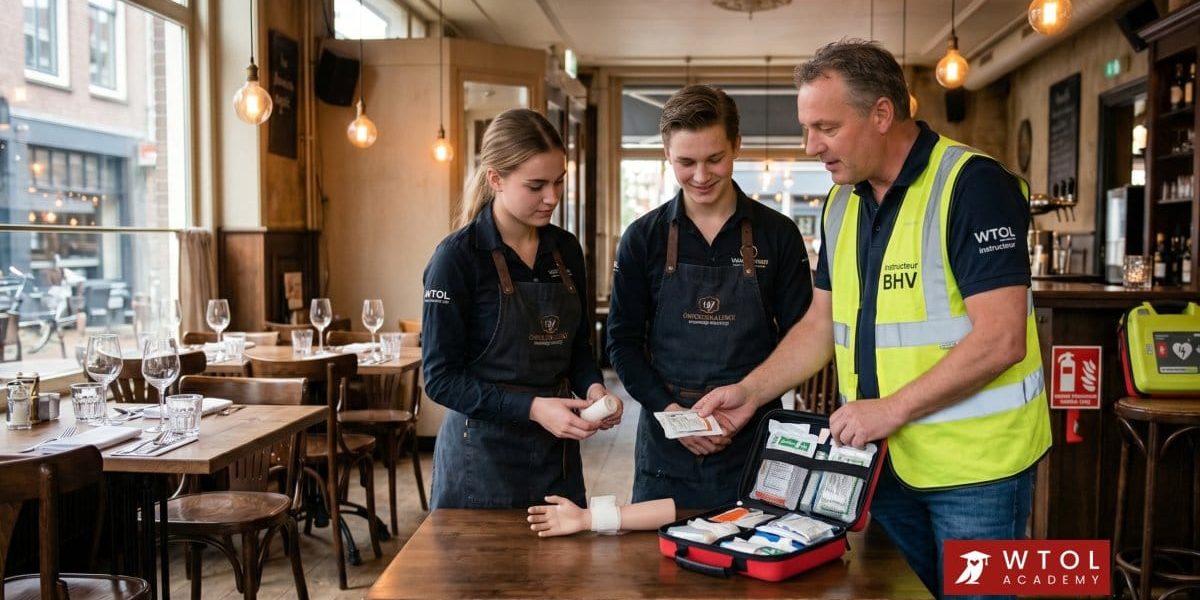
Whilst you can gain a lot of knowledge online, you cannot train muscle memory behind a screen. The practical training, which usually lasts four to eight hours, is therefore the beating heart of the course. Here, everything revolves around the physical actions that are life-saving. Under the guidance of an experienced instructor, your team intensively practises with the resuscitation dummy and the AED device. There is ample opportunity to practise, make mistakes, and refine techniques. By working with simulated casualties who mimic realistic hospitality emergencies, such as choking in the dining area or a panicked guest, the stress of a real incident is simulated.
Our instructors act as master-mentors during this day. They understand that a bartender reacts differently from a chef and adapt their guidance accordingly. This personal approach not only makes the training more effective but also strengthens team cohesion. It builds a culture of safety where everyone can rely on each other. Do you want to know more about how we integrate these modern educational forms into our accredited vocational courses? Then view our full range of courses for the ambitious hospitality professional.
Legal Frameworks and the Working Conditions Act in the Netherlands
Dutch legislation is clear: as an entrepreneur, you are ultimately responsible for the safety of everyone in your establishment. The Working Conditions Act obliges you to organise effective company emergency response. This begins not with simply appointing an employee, but with the Risk Inventory and Evaluation (RI&E). This document forms the foundation of your safety policy. In it, you record the specific risks your hospitality business faces, such as working with open flames or dealing with large groups of people in a small space. Based on this evaluation, you determine how many employees must follow an emergency response officer hospitality refresher course to keep their knowledge up-to-date.
The number of required Emergency Response Officers is not a fixed figure. It’s about customisation. A crucial rule is that at least one certified first aider must always be physically present as long as work is being done. This means not only during opening hours but also during early preparations in the kitchen or the late cleaning crew after closing time. Many entrepreneurs make the mistake of only looking at peak hours, but the inspectorate checks the full staffing throughout the entire workday. You must therefore take into account illness, holidays, and shift work when determining your total pool of first aiders.
Emergency Response Officers and social hygiene: an integrated approach
Safety does not stop at extinguishing a fire or applying a plaster. In hospitality, there is a strong interaction between physical safety and guest behaviour. A safe environment therefore requires an integrated approach where Emergency Response Officers and social hygiene reinforce each other. Where the Emergency Response Officer intervenes in medical incidents, the holder of the social hygiene diploma ensures responsible alcohol provision and the prevention of escalations. Do you want to know exactly how this is legally regulated? Then read our guide on social responsibility for all details about the Alcohol Act. Combining these expertises creates a team that maintains control both medically and socio-emotionally during unexpected situations.
Controls and enforcement by the Dutch Labour Inspectorate
In 2026, enforcement of the Working Conditions Act will be further tightened by the introduction of the Collective Act SZW 2026. The Dutch Labour Inspectorate carries out stricter controls on the presence and adequacy of workplace safety protocols. During an inspection, you must be able to immediately demonstrate that your RI&E is up-to-date and that your employees have valid certificates. The absence of an up-to-date emergency response officer hospitality refresher course can lead to substantial fines that are immediately noticeable per violation. Moreover, insurers critically examine your administration in the event of damage claims. If your safety register is not in order, this can seriously jeopardise the payout of your policy. Therefore, ensure that your certification never expires and your administration is always up-to-date.
Are you curious about how you can officially certify your team efficiently according to the latest national quality standards? View our practical courses and safeguard the continuity of your business.
Why Choose an Emergency Response Officer Refresher Course for Hospitality at WTOL Academy
Safety is not a side issue; it’s a craft. At WTOL Academy, we approach the emergency response officer hospitality refresher course from the perspective of the host and the chef. We understand that your employees prefer to be busy with their profession rather than with thick law books. That’s why our master-mentor approach is entirely focused on what actually happens between the bar and the kitchen. Our instructors speak the language of the sector. They know what it’s like to perform under pressure when the establishment is full and tension rises. This ensures training that not only meets the legal requirements of 2026 but also truly inspires your team to work more professionally.
We leave the dry theory behind. Instead, we focus on practical applicability that yields direct results in the workplace. An employee who feels competent radiates that to guests. By choosing a specialist who understands the dynamics of hospitality, you prevent the training from feeling like a mere formality. It becomes an opportunity for personal enrichment and a strengthening of team spirit. With our nationwide coverage, you’ll always find a training location nearby, or we can come to you for a customised session.
Hospitality education with passion and craftsmanship
We believe in an integrated approach to professional competence. Our passion for wine, beer, and hospitality is directly reflected in the way we conduct safety tests. It is much more efficient to place all your hospitality courses with one trusted partner who knows the sector’s standards inside out. Our SVH-accredited quality guarantees that the emergency response officer training seamlessly aligns with your team’s other qualifications. You receive personal guidance from professionals who have spent years on the floor themselves. They understand that safety is the invisible foundation of a successful evening and convey that knowledge with infectious enthusiasm.
Enrol for the refresher in 2026
Prevent surprises during an unexpected inspection. In 2026, the rules surrounding enforcement are stricter than ever, and it is crucial to renew your certificate in good time. An expired certification can have major consequences for your insurance and the safety of your guests. Fortunately, enrolling for the emergency response officer hospitality refresher course is very simple. You can register individual employees directly online for one of our open training sessions. Do you have a larger team? Then opt for the customised options of an in-company training at your own establishment. We then train in the familiar environment of your own kitchen and restaurant, which makes the scenarios even more realistic. Ensure you are at the forefront of welcoming safety and schedule the refresher today.
Invest Today in Tomorrow’s Safety
Safety in hospitality is a dynamic process that requires constant attention and craftsmanship. By choosing an emergency response officer hospitality refresher course, you ensure that your team not only meets the stricter requirements of the Working Conditions Act in 2026 but also acts with confidence during critical moments. The combination of flexible e-learning and intensive practical training offers the ideal solution for entrepreneurs who take safety seriously without jeopardising staffing levels.
As an SVH-accredited training institute and specialist in hospitality since 2014, WTOL Academy understands the unique challenges of your workplace like no other. Our high customer satisfaction among hospitality professionals proves that learning with us is an opportunity for true professionalisation. Don’t wait until an inspection or an incident forces you to act, but take control of safety in your establishment.
**View the emergency response officer hospitality refresher course and enrol directly ** to safeguard the hospitality and continuity of your business. We look forward to raising the standard for safety in the sector together with your team.
Frequently Asked Questions About the Emergency Response Officer Refresher Course for Hospitality
Is an emergency response officer hospitality refresher course mandatory every year?
Yes, an annual emergency response officer hospitality refresher course is necessary to maintain the validity of the certificate and comply with the Working Conditions Act. The law stipulates that the current knowledge and skills of a first aider must always be up-to-date. By training every year, you ensure that life-saving actions remain automatic. This is not only crucial for safety in your establishment but also prevents sanctions during inspections by the Dutch Labour Inspectorate.
How long does an emergency response officer hospitality refresher course typically last?
The duration of the training depends on the chosen learning format, but with a blended learning trajectory, the practical training usually takes four to eight hours. Prior to this physical day, you complete the theory via e-learning at your own pace. This efficient approach ensures that employees are away from the workplace for a minimal amount of time, whilst the focus during the session is entirely on active skills and realistic scenarios.
What is the difference between a basic course and an emergency response officer refresher course?
A basic course is intended for employees who have not previously obtained a certificate and covers all fundamentals very extensively. The emergency response officer hospitality refresher course is specifically designed for already certified first aiders who want to maintain their competence. Here, the emphasis is on recent updates to guidelines and intensive practice of practical situations, making the training more compact and focused on the daily dynamics of a hospitality business.
Can I also follow the emergency response officer hospitality refresher course online?
You can complete the theoretical part entirely online via our interactive e-learning modules on your mobile or tablet. However, for physical actions such as resuscitation and fire fighting, a practical day on-site is indispensable according to national quality standards. Training muscle memory and working with resuscitation dummies simply cannot be done exclusively digitally. This combined method offers the ideal balance between flexibility for your rota and necessary physical skill.
How many emergency response officers must be present in my restaurant?
There is no fixed number per square metre, but the law states that at least one first aider must always be present as long as work is being done. You determine the exact number based on your Risk Inventory and Evaluation (RI&E). Always take into account different shifts, holiday periods, and potential absenteeism within your team, so that the safety of your guests and staff is guaranteed at all times of the day.
Is the WTOL Academy certificate officially recognised?
Yes, the certificate you receive after successfully completing the training is officially recognised and complies with all legal requirements. As an SVH-accredited training institute, we guarantee that the content of the course seamlessly aligns with national standards and the specific needs of the hospitality sector. This provides entrepreneurs with the assurance that they have the correct and valid documentation for inspections by the Labour Inspectorate or for insurance matters.
What should I do if my emergency response officer certificate has already expired?
When a certificate has expired, you are officially no longer certified and do not comply with the obligations of the Working Conditions Act. It is of great importance to schedule new training as soon as possible to restore your competence. In many cases, you can still participate in a refresher course if the expiry date is not too far in the past, but do not delay to avoid legal risks and problems with your insurance policy.