


The future of your hospitality business doesn’t rest on your menu, but on the shoulders of the talent you train today. As an experienced professional, you know that passing on craftsmanship is an art in itself, but the step towards an official role as an SVH master trainer sometimes feels like a hurdle. Perhaps you’re daunted by pedagogical theory or simply have little time to build an extensive portfolio alongside your busy job. That’s a familiar feeling in a sector where hands always need to be busy.
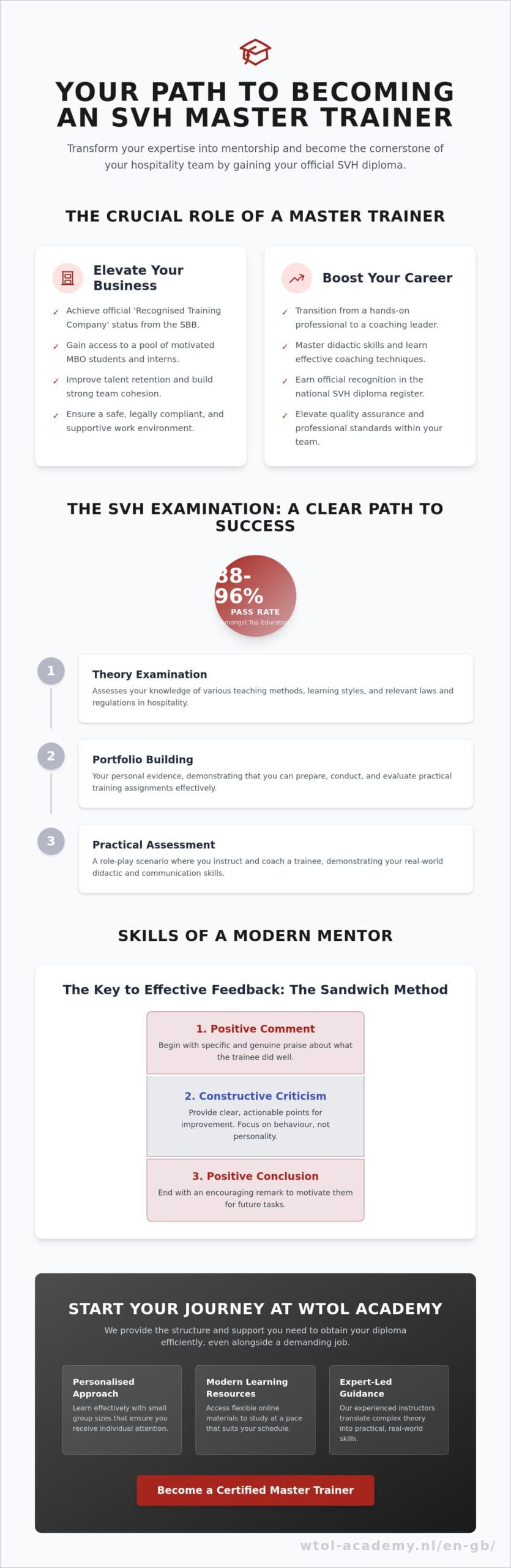
Nevertheless, obtaining your diploma is the key to growing your business and meeting the legal requirements of the SBB for recognised training companies. In this article, you’ll discover exactly how to become a recognised SVH master trainer and learn how to guide trainees with confidence. With pass rates among top educators ranging between 88% and 96%, achieving the diploma is a feasible goal for any driven professional. We’ll discuss the structure of the examination, from the portfolio to the practical assessment, so you know exactly what’s needed to successfully pass on your passion for the profession to the next generation.
Key Points
- Understand why a qualified SVH master trainer is indispensable for the status of a recognised training company and the professional growth of your team.
- Discover the specific steps of the examination process, from mastering didactics to successfully completing the theory and practical components.
- Learn the essential difference between managing and coaching, and how to give effective feedback to trainees using the sandwich method.
- Get practical tips for building a strong portfolio and practising instructional conversations with colleagues.
- Experience how a personal approach with small groups and modern online learning resources helps you efficiently obtain your diploma alongside your work.
Table of Contents
What is an SVH master trainer and why is this role crucial?
In a busy kitchen or a bustling restaurant, the SVH master trainer is the linchpin around which everything revolves. It’s much more than a certificate on the wall. It’s an official recognition that you possess the skills to train the next generation of professionals. This role finds its deep roots in the historical context of master craftsmen, where knowledge was directly passed from master to apprentice. Nowadays, the master trainer forms the indispensable bridge between the theoretical foundation that trainees receive at school and the challenging reality of the workplace. Without this expert guidance, valuable knowledge is lost, and the quality of service is directly jeopardised.
However, a good mentor does more than just give instructions. You foster cohesion within the team. When employees feel supported in their personal growth, they stay with your company longer. This is essential in a sector where talent retention is a daily challenge. Often, the link with other certifications such as social hygiene is overlooked, but precisely that combination is important. As a master trainer, you are also responsible for the safe working environment in which the trainee develops. This synergy between various professional diplomas completes the foundation of a hospitality professional.
The benefits for the entrepreneur and the employee
For the entrepreneur, having a qualified SVH master trainer means the official status of a recognised training company. This provides direct access to a pool of motivated interns and students who want to take their first steps in the profession. For the employee themselves, it’s a huge boost for their career. You grow from an executive professional to a coaching leader. You learn how to elevate quality assurance within the team and ensure that standards don’t slacken when pressure increases.
Legal frameworks and the SVH register
The role of master trainer is firmly embedded in Dutch legislation via the Samenwerkingsorganisatie Beroepsonderwijs Bedrijfsleven (SBB – Cooperation Organisation for Vocational Education, Training and the Labour Market). A hospitality business may only train students from MBO (intermediate vocational education) programmes if a certified supervisor is present. After successfully completing your course, you will be included in the official SVH diploma register. This register functions as the national quality standard demonstrating that you meet the strictest requirements in terms of didactics and coaching. View the range of courses offered by WTOL Academy to see how you can take this step in your professional career.
How to obtain the SVH master trainer diploma?
The journey to obtaining your diploma is a structured path that transforms you from a specialist to a coach who inspires others. This process begins with choosing a recognised educator who not only covers the theory but also translates it into your daily practice. Obtaining the official SVH Master Trainer diploma is not simply a matter of sitting through a course. It requires active commitment and a critical look at your own communication style. The route consists of four clear steps: enrolment, mastering the theory, building a portfolio, and successfully completing the final practical examination.
Preparation is half the battle here. You’ll notice that the focus during the training shifts from ‘what’ you do to ‘how’ you convey this to someone else. This requires a different mindset. Where you might previously have been used to quickly tackling tasks yourself, you now learn how to create space for a trainee to make mistakes and grow from them. Do you want to see which start dates are available for your course immediately? Then view the overview of courses and take the first step.
The three components of the SVH examination
The examination for the SVH master trainer is divided into three crucial components that together demonstrate your competence. The first part is the theory examination. This assesses your knowledge of various teaching methods, learning styles, and relevant laws and regulations in hospitality. The second component is the portfolio. This is your personal evidence demonstrating that you can prepare and evaluate practical assignments. Finally, the practical examination follows. This is often a role-play where you instruct and coach a trained actor. Here you show that you possess didactic skills and can calmly make adjustments where necessary.
Admission requirements and preparation
Before you begin, it’s essential that you possess sufficient professional knowledge in your specific discipline, whether that’s in the kitchen, service, or behind the bar. An important basic prerequisite for many master trainers is holding the social responsibility diploma. This forms the legal basis for responsible work in hospitality. In terms of time commitment, in addition to the course days, you should allow approximately 10 to 15 hours for self-study. This is necessary for reviewing the course material and carefully completing your portfolio. Good planning is therefore indispensable for busy hospitality professionals.
The skills of a modern mentor in hospitality
You recognise a true master-mentor not by a stern face, but by the growth of their team. In the hustle and bustle of hospitality, it’s tempting to focus solely on results: orders must be processed, and glasses must shine. That’s managing. As an SVH master trainer, you go a step further by coaching for growth. You don’t just look at what goes wrong, but you ask why it happens and how the trainee can arrive at a solution themselves. Obtaining the SVH Master Trainer Diploma provides you with the didactic tools to professionally guide this process. Patience and empathy are your most important instruments here. After all, you are not only an instructor but also a confidant who creates a safe environment where making mistakes is seen as an essential part of the learning process.
Recognising and utilising learning styles
Every trainee is unique and learns in their own way. The psychologist Kolb distinguishes four types: the activist, the reflector, the theorist, and the pragmatist. An activist wants to get straight to work with the espresso machine, whilst a reflector prefers to first observe how you create perfect latte art. As a mentor, you adapt your instructional method accordingly. For a theorist, you explain the underlying theory of the grind setting, whilst you challenge the pragmatist to experiment directly with different settings. By recognising these styles, you prevent frustration for both yourself and the trainee. You ensure that the challenge is just big enough to stimulate, without becoming overwhelming.
Effective communication in the workplace
Communication is the lubricant of a well-run business. A common pitfall is overloading young employees with too much complex professional knowledge at once. Instead, use the sandwich method for feedback: start with a compliment, then point out the area for improvement, and conclude with positive encouragement. This keeps motivation high, even when things are tough. Use questioning techniques that encourage self-reflection. Instead of saying "you’re holding the tray incorrectly," ask: "how does the balance of your tray feel at the moment?". This forces the trainee to consciously think about their own actions.
Sometimes you’ll encounter resistance or motivation problems, especially with young employees who are still finding their feet. A modern mentor understands that motivation often stems from a sense of purpose. Explain why a particular action is important for the guest experience or the team’s efficiency. By involving the trainee in the bigger picture, you transform a simple task into a valuable contribution to the business’s success. Do you want to further sharpen your communication skills? Then discover the various courses that will help you take that next step as a mentor.
Preparation for the SVH examination: tips for success
The examination for SVH master trainer is the ultimate test of competence where everything you have learned comes together. Many hospitality professionals dread the paperwork and theoretical terms, but with a structured approach, there’s no reason for uncertainty. Success begins with an early start. Don’t wait until the last week to gather evidence for your portfolio. By immediately documenting practical examples, you prevent having to dig deep into your memory for suitable learning situations just before the deadline. When studying the theory, focus primarily on the core concepts of didactics and ensure you are familiar with the latest qualification files from the SBB. These files form the basis of what a trainee must know and be able to do.
Practice makes perfect, especially with the dreaded instructional conversation. Ask an experienced colleague or even your partner to act as a ‘trainee’. The more often you articulate the steps of an instruction aloud, the more natural it will feel during the actual examination. Do you want to be sure you don’t overlook any details? Then enrol in one of WTOL Academy’s targeted courses and prepare for your diploma under professional guidance.
Assembling a winning portfolio
For many, the portfolio is the most daunting component, but it is simply proof of your craftsmanship as a supervisor. According to SVH standards, this document must contain at least a description of the training placement, various practical assignments, and evaluation reports. The art is to translate your daily actions into concrete learning objectives. Have you explained to a trainee how to prepare a mise-en-place? Then describe not only the task but also how you checked whether the trainee understood the logic behind it. Ensure a clear presentation with a distinct table of contents; a well-organised portfolio immediately conveys authority and professionalism to the examiner.
The practical examination: calm and authority
During the practical examination, everything revolves around the interaction with the trainee. Nerves can strike during the role-play, but remember that the examiner is looking at your process, not a flawless execution of the hospitality tasks themselves. Stick to the proven structure of good instruction: demonstrate, do together, and imitate. This provides guidance for you and clarity for the trainee. A crucial moment takes place immediately after the examination: self-reflection. Be honest about what went well and what you would approach differently next time. An SVH master trainer who can critically assess their own role shows that they truly have a knack for coaching.
Start your journey at WTOL Academy: from professional to mentor
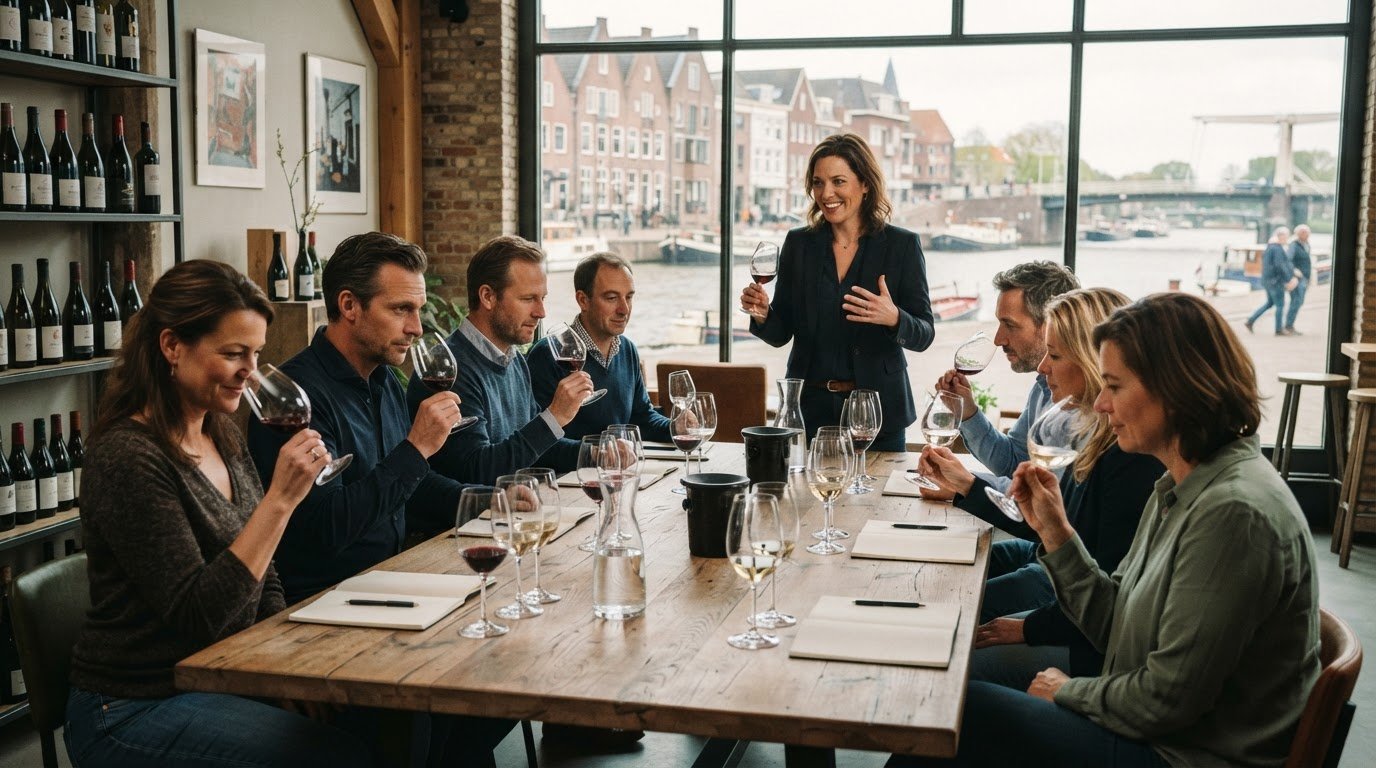
Taking the step to become an SVH master trainer is an investment in yourself and in the future of Dutch hospitality. At WTOL Academy, we understand that you don’t have time for dry theory that doesn’t connect with the reality of the workplace. That’s why we resolutely opt for a personal approach in small groups. This ensures a safe learning environment with ample room for interaction and personal feedback. You learn not just from a book, but by doing and reflecting under the guidance of instructors who are themselves actively involved in the hospitality industry. They know the challenges of a busy shift and understand exactly how to apply didactics without losing service speed.
Our unique methodology combines modern online learning resources with intensive practical days. This hybrid form of education is ideal for busy professionals; you prepare the theory at times that suit you, allowing us to delve straight into the depth during the sessions. After obtaining your diploma, it doesn’t stop there with us. Many of our course participants progress to other specialisations to further broaden their expertise, such as the sommelier training. This way, you continuously develop yourself as the expert your company needs.
Our methodology: passion meets profession
We believe that a ‘master-mentor’ resides within every experienced hospitality employee. Our mission is to bring that personality out in you. During the course, we offer intensive support for the component that often raises the most questions: building your portfolio. We guide you step-by-step through the SVH requirements, so you can approach the examination with confidence. Furthermore, your participation grants you direct access to our extensive network of passionate hospitality professionals. This network is a valuable source of knowledge and inspiration, long after you have received your certificate.
Enrolment and practical information
Are you ready to take the next step in your career? The process is simple and focused. On our website, you can directly view the available dates for the next master trainer course. We also advise you to enquire about current possibilities for subsidies or tax advantages; although the well-known STAP scheme has changed, there are often regional or sectoral funds available for professional development in hospitality. For a complete picture of how we can support your growth, we kindly refer you to the overview of all our courses . Don’t wait any longer and transform your passion for the profession into the skill to help others shine.
Invest in the future of your team and yourself
Obtaining your diploma is more than a tick on your CV; it’s the transformation from an experienced professional to an inspiring guide. You now have a clear picture of the course, from building a solid portfolio to mastering the didactic skills necessary for modern leadership. By taking on the role of SVH master trainer, you not only safeguard quality within your company but also ensure the much-needed influx of new talent into the sector. The balance between theoretical knowledge and daily practice forms the basis for a healthy learning environment where everyone can grow.
At WTOL Academy, you benefit from a personal approach and high pass rates, thanks in part to our instructors who are themselves actively involved in the industry daily. As an SVH-accredited training institution, we offer the personal guidance you need to approach your examination with confidence and achieve immediate results in the workplace. Become a recognised mentor and enrol in the SVH master trainer course at WTOL Academy. We look forward to working with you to elevate craftsmanship in hospitality to a higher level.
Frequently asked questions about the SVH master trainer diploma
Is the SVH master trainer diploma compulsory for every hospitality business?
No, the diploma is not compulsory for every hospitality business, but it is necessary if you want to be a recognised training company. Only with a qualified SVH master trainer are you officially allowed to supervise and train MBO (intermediate vocational education) trainees. This is a strict requirement from the SBB to guarantee the quality of practical education in hospitality. For businesses that do not take on interns, it is a valuable method for team development, but not a legal obligation.
How long does the SVH master trainer course typically last?
A typical course to become an SVH master trainer lasts three teaching days, often spread over several weeks. This spread is essential because you work on your portfolio and study the theory between sessions. In addition to the course days, allow approximately 10 to 15 hours for self-study to prepare assignments and master the didactic principles. It is therefore an intensive but manageable course for busy professionals.
What is the difference between a master trainer and a practical supervisor?
A master trainer is an officially SVH-certified coach, whilst a practical supervisor is a general job title for someone who gives instructions in the workplace. In hospitality, you may only officially call yourself a master trainer once you have obtained the SVH diploma and are included in the register. A practical supervisor does not have the authority to officially assess trainees for their MBO (intermediate vocational education) programme or to act as a point of contact for the SBB.
Can I also take the SVH master trainer examination in English?
Yes, it is possible to take the master trainer examination in English at the SVH. This is ideal for international professionals working in Dutch hospitality who wish to formalise their coaching skills. Please note that the course materials and guidance during the training must also be available in English at your chosen institution. This makes the diploma accessible to the diverse talent in our sector.
How long is the SVH master trainer diploma valid?
The SVH master trainer diploma is valid indefinitely and never needs to be renewed after being obtained. Once you have successfully completed the examination and your registration in the SVH register is a fact, you retain this status for the rest of your career. However, it is advisable to keep your knowledge of qualification files and didactic methods up to date. Educational standards can change over the years due to new legislation.
What are the costs for the SVH master trainer examination?
The costs for the course depend on the chosen training format and whether the examination is included in the total package. As prices can vary per year and per provider, it is advisable to consult the current overview on our website. Often, the costs are tax-deductible for entrepreneurs, or you can make use of sector-specific subsidies. This makes the investment in your staff’s professional growth financially more attractive.
Can I become a master trainer without hospitality experience?
You can follow the theoretical training, but effectively becoming a master trainer without hospitality experience is not feasible in practice. A mentor must possess sufficient professional knowledge to be able to transfer it to a trainee. Whilst the examination assesses your didactic skills, during the practical assignments you must demonstrate that you can substantively instruct a trainee in a specific hospitality discipline, such as the kitchen or service.
What happens if I fail one of the three examination components?
If you fail one of the three examination components, you only need to retake that specific part. Your achieved results for the other components remain valid, and you do not need to redo them. This provides reassurance, as you can fully focus on improving, for example, only your portfolio or the practical component. As soon as you have successfully completed all three components with a pass, you will still receive the official diploma.