


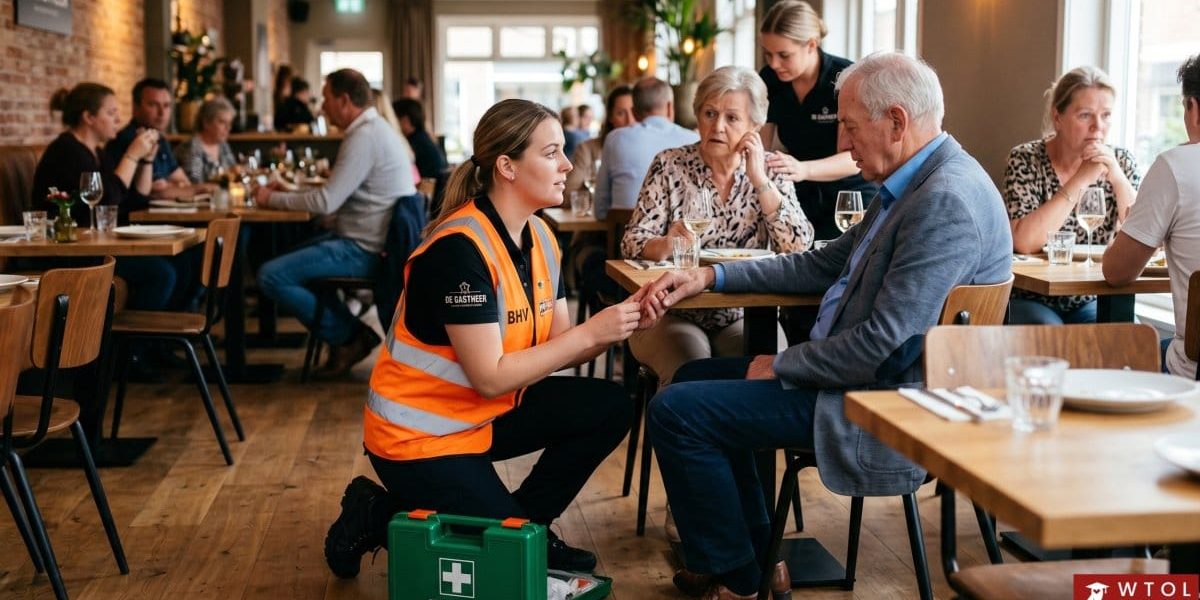
Imagine this: it’s a busy Saturday night, your terrace is packed, and suddenly a guest chokes severely or an incident occurs with an aggressive visitor. At such a critical moment, every second counts, and your team must instinctively know how to act. Finding the right Emergency Response Officer (ERO) course for hospitality is therefore more than just a legal obligation under the Health and Safety Act; it’s the foundation of a safe and welcoming environment for both your guests and your staff.
You understand better than anyone that safety is a priority, but the ambiguity surrounding regulations and the tricky task of scheduling often make planning training a challenge. You want a certified team that exudes calm, even when the pressure is high. Discover in this buying guide how to choose a course that seamlessly fits the dynamics of your business and meets the requirements for 2026. We’ll take you through the latest trends, such as blended learning, and show you how to combine professional emergency response with a passion for the hospitality profession.
Key Points
- Learn why an Emergency Response Officer course for hospitality goes beyond the law and how to effectively respond to specific risks such as kitchen fires and medical emergencies on a busy terrace.
- Discover which specific modules, such as first aid for choking and extinguishing fat fires, are essential for a safe working environment in the sector.
- Understand the benefits of blended learning to schedule training flexibly without disrupting the daily operations of your hospitality business.
- Gain clarity on determining the correct number of emergency responders based on your specific business size and the applicable Health and Safety Act guidelines.
- Discover how to combine safety and mastery by cleverly integrating ERO certification with other recognised professional training courses for your team.
Table of Contents
Why an Emergency Response Officer course for hospitality is essential for your business
What should a good Emergency Response Officer course for hospitality cover?
The choice between e-learning and practical Emergency Response Officer training
How many Emergency Response Officers do you need in hospitality?
Getting your Emergency Response Officer certificate at WTOL Academy
Why an Emergency Response Officer course for hospitality is essential for your business
In a bustling hospitality business, everything revolves around the perfect atmosphere and impeccable service. But behind the scenes, there are risks you cannot ignore. A pan fire, a guest becoming unwell on a busy terrace, or an employee cutting themselves during preparation; these are scenarios you’d rather not think about, but for which you must be prepared. An Emergency Response Officer course for hospitality is therefore not an administrative burden, but an essential part of your professionalism. It enables your team to act calmly when pressure is at its maximum.
Many entrepreneurs view company emergency response as a mere formality. That’s a missed opportunity. If you understand what company emergency response is at its core, you’ll see that it’s about ensuring continuity. A trained emergency responder knows exactly how to extinguish an incipient fire before the entire kitchen is lost. This mastery ensures that an incident remains a footnote rather than a disaster that closes your business for weeks.
Safety as part of hospitality
Hospitality doesn’t stop at serving a good glass of wine. It’s also about providing a safe haven. When panic threatens to break out among a large group of guests, the ERO is the rock in the storm. By acting calmly and decisively, you protect not only physical safety but also the reputation of your business. Guests remember not only the incident, but especially how professionally you and your team resolved it. An ERO is, in this sense, the ultimate host who watches over the well-being of everyone on the premises.
Legal frameworks and the role of the Health and Safety Act
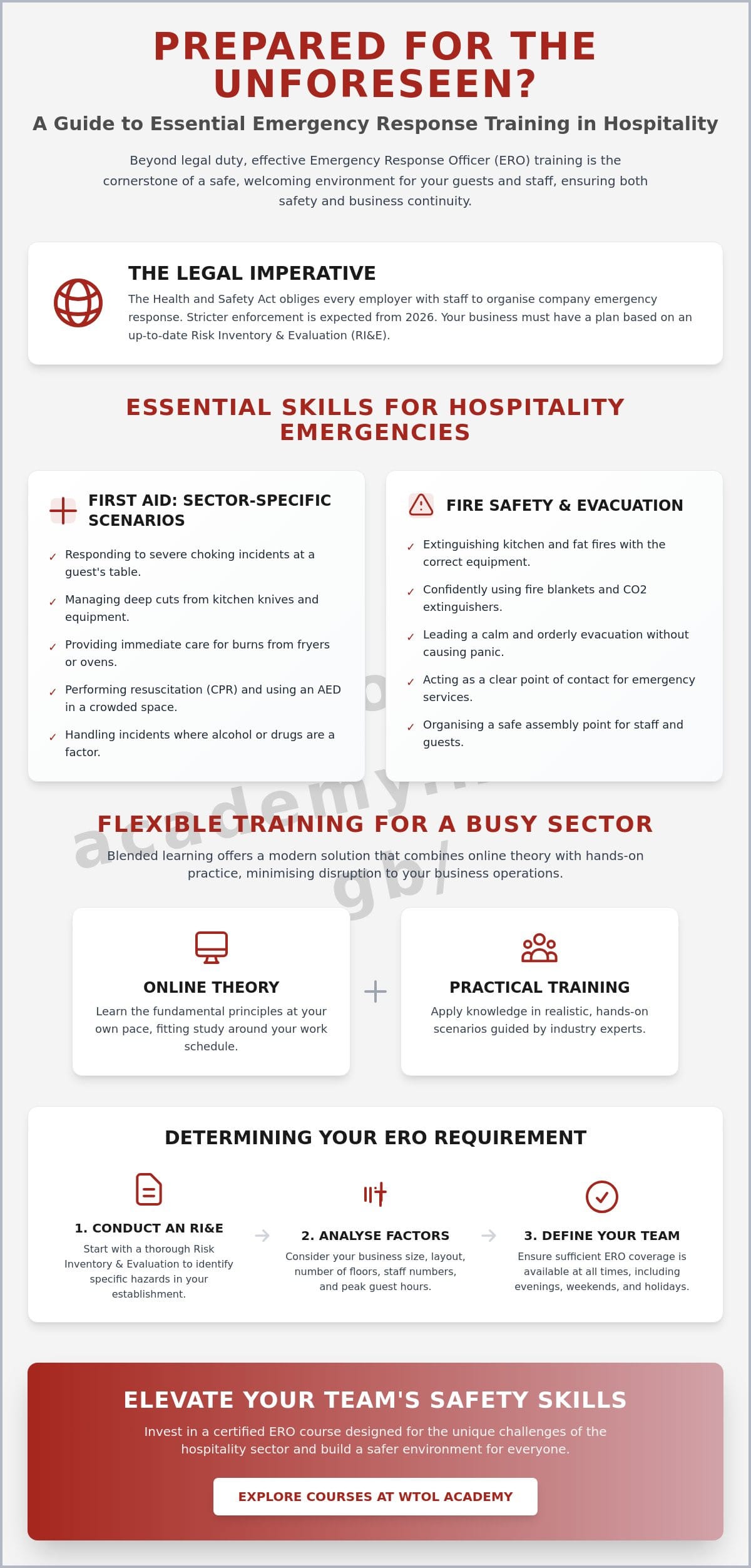
In the Netherlands, the legislation is crystal clear. The Health and Safety Act obliges every employer with at least one employee to properly organise company emergency response. In 2026, enforcement by the Dutch Labour Inspectorate will be stricter than ever. As an entrepreneur, you are responsible for a comprehensive ERO plan based on an up-to-date risk inventory and evaluation (RI&E). This document is the foundation; it determines how many emergency responders must be present based on the specific hazards in your establishment. Ignoring these rules can lead to hefty fines, but worse still, to personal liability in the event of accidents. By investing in recognised training courses , you not only comply with the law but also invest in the future of your staff.
What should a good Emergency Response Officer course for hospitality cover?
A standard safety training simply isn’t sufficient for the dynamics of a professional kitchen or a busy café. Where an office worker might encounter someone fainting by the coffee machine, an ERO in hospitality must know how to act in the event of a deep cut from a chef’s knife or severe choking at a table full of guests. A quality Emergency Response Officer course for hospitality distinguishes itself by focusing on these specific practical scenarios. This involves the unique balance between acting rapidly and maintaining calm in the establishment.
It’s important to remember that these skills directly align with the Health and Safety Act obligations for employers. The law requires that emergency response is tailored to the nature of the risks within your business. For a hospitality establishment, this means your team not only learns to apply plasters but also understands how to communicate in a noisy environment and how to deal with incidents where alcohol or drugs play a role.
First aid for hospitality-specific incidents
In hospitality, burns and deep cuts are daily risks. A good course teaches your staff how to immediately stabilise these injuries with the correct materials. Furthermore, resuscitation in a public space is a specialised skill. You have to deal with bystanders, loud music, and limited space. The training must address the use of an AED whilst simultaneously keeping the crowd at a distance. Recognising symptoms in guests who are under the influence is also crucial; this requires a specific approach that seamlessly aligns with the standards of SVH Social Hygiene.
Fire safety and evacuation plans
Kitchen fires, and specifically fat fires, require a specialist approach. The incorrect use of water can have catastrophic consequences. A hospitality ERO therefore learns to instinctively work with fire blankets and CO2 extinguishers. In an evacuation, the ERO’s task is to guide guests to emergency exits without panic breaking out. This requires strong communication skills and a natural authority. Moreover, the ERO acts as the point of contact for emergency services, where a clear handover of the situation can be life-saving. Do you want to take your team to a higher level? Then take a look at the various training courses that combine safety with hospitality mastery.
The choice between e-learning and practical Emergency Response Officer training
Planning training for an entire team in hospitality is often a logistical challenge. With varying rotas, evening shifts, and busy weekends, it’s almost impossible to get everyone into a classroom at the same time. That’s why modern Emergency Response Officer courses for hospitality are now almost always structured as blended learning. This method combines the depth of digital theory with the indispensable power of a physical practical day. It offers the flexibility you need as an entrepreneur, without compromising the quality of emergency response.
Flexible study with e-learning
The theoretical foundation can now be laid at your own pace. Through the online learning environment of WTOL Academy, employees can study the course material when it suits them; whether that’s before an early shift or during a quiet afternoon. Interim knowledge tests monitor progress. This ensures that everyone starts the practical day with the same level of knowledge. For international teams, this digital format is ideal, as the course material is often available in both Dutch and English. This significantly lowers the barrier to participation and ensures that safety becomes a shared language within your company.
The value of a practical day on-site
Whilst theory is essential, you don’t learn to extinguish a fire from a screen. The adrenaline released during a realistic exercise cannot be simulated in an app. During a practical day on-site, the team practises scenarios that actually occur in the hospitality workplace. Think of resuscitation amongst tables or evacuating a crowded bar. Direct feedback from experienced mentors ensures that actions are immediately corrected and refined. Training together also strengthens mutual trust; afterwards, you know exactly who you can count on when it really matters.
When choosing between different providers, it’s tempting to only look at the lowest price. However, the investment in a quality Emergency Response Officer course for hospitality is one that pays for itself many times over. Cheap is often expensive if the training is too generic or if the practical assessment is insufficient. Choose a partner who understands the sector and who seamlessly connects theory to daily practice. This way, you transform a legal obligation into an opportunity for personal growth and professionalisation for your entire team. View our range of training courses to see how we perfectly balance theory and practice.
How many Emergency Response Officers do you need in hospitality?
The question of how many emergency responders should be present within a hospitality establishment often leads to confusion. There is no fixed legal number such as ‘one in ten employees’. The Health and Safety Act stipulates that there must always be sufficient staffing to guarantee the safety of guests and personnel. This means that when planning an Emergency Response Officer course for hospitality, you must consider your maximum capacity, the type of business, and opening hours. The goal is that at any time of day, someone is present who knows how to act in an emergency.
The rule of ‘always present’ is the most important yardstick. You must account for illness, holidays, and shift patterns. If your business is open from early morning until late at night, you need a larger pool of trained employees than a lunchroom that only operates between eleven and four. A good rule of thumb is to train at least two to three employees per shift, so you are never caught off guard by unexpected absences or sudden crowds.
Calculation based on risk profile
The risk profile of your establishment determines the ultimate need. A nightclub, for example, deals with factors such as loud music, limited light, and alcohol consumption. This requires more EROs than a quiet coffee bar where the risks are lower. The layout of the premises also plays a role; a monumental building with narrow stairs is more difficult to evacuate than a modern, single-storey location. For a complete overview of how to integrate this safety with other professional training courses, you can visit our training courses page .
Organisation of ERO staffing
Safety only works if it is part of the daily routine. Therefore, integrate ERO roles into the daily briefing. Assign who has primary responsibility in an incident for each shift. For larger establishments or hotels, it is advisable to appoint a head ERO or team leader to take on coordination. Also, do not forget the annual refresher. Knowledge quickly fades, especially in a sector where incidents fortunately do not occur daily. By taking an Emergency Response Officer course for hospitality annually, the certificate remains valid and the knowledge stays fresh.
Do you want to be sure that your team meets all requirements and is prepared for every scenario? Invest in the mastery of your staff and book the right training today for your business.
Getting your Emergency Response Officer certificate at WTOL Academy
WTOL Academy is not just a training institute; we are the master mentor who bridges the gap between safety and hospitality. Where many providers stop at dry theory, we go further. An Emergency Response Officer course for hospitality with us means you learn from professionals who have themselves worked in the field for years. Our trainers understand the hectic pace of a busy terrace and the specific risks of a professional kitchen. We believe that learning is not an obligation, but an opportunity for personal enrichment and professionalisation of your entire team.
A major advantage of our approach is the ability to cleverly combine certifications. You can effortlessly integrate ERO with other essential training courses such as SVH Social Hygiene or SVH Master Trainer. All our diplomas enjoy national recognition by SVH, which directly strengthens the status of your business and the competence of your staff. Thanks to our national coverage, there is always a training course nearby, but we go a step further with our customisation. With our in-company training, we come to your location to practise directly in your own workplace. This makes the training tangible and ensures that employees know exactly where the extinguishing agents and escape routes are in their own establishment.
The WTOL method: passion for the profession
Our trainers speak the language of hospitality. No endless PowerPoint presentations, but action and interaction are central. We focus on practical applicability; what do you do when real panic breaks out? This hands-on approach ensures that knowledge is retained and employees confidently take on their role as emergency responders. In addition, we completely relieve you of the administrative process. We support with registration in the relevant registers, so you can focus on what you love to do most: running a successful business.
Ready for the next step in professionalisation?
Safety is the basis of mastery. When your team knows they can handle any situation, the overall quality of your hospitality increases. Investing in an Emergency Response Officer course for hospitality is therefore a direct investment in the growth of your employees as professionals. Do you want to know more about other legal requirements that will take your business to a higher level? Then also check out our comprehensive guide on social responsibility . Are you ready to seriously address safety in your business? Request a quote for your team directly via our website and discover the power of professional competence.
At WTOL Academy, you will find a reliable partner who understands both the business and human side of the hospitality profession. Together, we ensure a team that remains calm during emergencies and always guarantees the safety of your guests. View our full range of training courses and start professionalising your business today.
Take the step towards a safer hospitality team today
Safety is not a static tick-box on a checklist, but a living part of your professionalism. You have discovered that a good Emergency Response Officer course for hospitality goes far beyond merely complying with the Health and Safety Act; it is the guarantee that your team can welcome guests with peace of mind and complete control. By cleverly combining theory and practice through blended learning, you keep the barrier to participation low and the impact on the workplace high. A team that knows exactly how to act in an incident radiates that calm to every guest in the establishment.
As an SVH-accredited training provider with national coverage in the Netherlands, WTOL Academy understands the unique challenges of your sector like no other. Our trainers speak the language of the workplace and share their years of hospitality experience to make every training a valuable opportunity for professionalisation. Don’t wait until a calamity occurs, but prepare your team now for success and safety.
View our range and enrol your team in an Emergency Response Officer course . Together, we build a business where hospitality and safety go hand in hand.
Frequently Asked Questions about the Emergency Response Officer course for hospitality
Is an Emergency Response Officer course mandatory for every hospitality business?
Yes, every hospitality entrepreneur with at least one employee is legally obliged to organise company emergency response. This is laid down in Article 15 of the Health and Safety Act. The employer must ensure that there are always sufficient emergency responders present who provide first aid, extinguish a fire, and guide an evacuation. Failure to comply with this obligation can lead to high fines from the Dutch Labour Inspectorate.
How long is an Emergency Response Officer certificate for hospitality valid?
Strictly speaking, an ERO certificate does not have a legal expiry date, but the law does require that emergency responders remain demonstrably competent. Therefore, the standard in the sector is that a certificate is valid for one year. By taking an annual refresher course, you ensure that knowledge of life-saving actions and fire fighting remains fresh. This is crucial in a dynamic environment where incidents fortunately do not occur daily.
Can I complete an Emergency Response Officer course entirely online?
No, a full Emergency Response Officer course for hospitality cannot be completed exclusively online. Whilst the theory can be excellently studied via e-learning, a physical practical day is indispensable for learning skills such as resuscitation and extinguishing fat fires. This hybrid form, also known as blended learning, offers the ideal balance between flexibility for your staff and the necessary practical experience in the workplace.
What is the difference between first aid and Emergency Response Officer in hospitality?
The main difference is the scope of tasks. A first aider focuses exclusively on medical assistance for accidents and illness. An ERO has a broader range of tasks that, in addition to first aid, also includes fire fighting and the coordination of an evacuation. In hospitality, an ERO is therefore the all-round safety expert who also knows how to tackle a kitchen fire or safely guide guests outside.
How many employees should I have trained as Emergency Response Officers?
There is no fixed number of employees you must train, but at least one ERO must always be present during opening hours. You determine the exact number based on your risk inventory and evaluation (RI&E). Always take into account holidays, illness, and different shift patterns. For an average establishment, this often means you need to certify at least two to three people per shift to ensure safety.
Are subsidies available for Emergency Response Officer training in hospitality?
Yes, subsidy schemes are regularly available through sector funds for hospitality or through regional incentive funds for training. As safety training contributes to the professionalisation of the sector, many bodies support the costs for training courses. It is advisable to inquire with your trade association or the relevant training fund about the current possibilities for your specific business and region to facilitate the investment in your team.
What must be included in an Emergency Response Officer kit for hospitality?
An ERO kit must comply with the basic guidelines of The Orange Cross, but for hospitality, extra additions are essential. Think of special burn gel and detectable blue plasters for employees in the kitchen. In addition, sterile gauze, emergency bandages, bandage scissors, and gloves should be included. Check the contents at least every six months for the expiry date of the products to guarantee usability during an incident.
Does an Emergency Response Officer also need to have the social hygiene diploma?
No, this is not a legal obligation, but it is strongly recommended for optimal safety in the establishment. Whilst the Emergency Response Officer course for hospitality focuses on emergencies, social hygiene is about preventing incidents caused by undesirable behaviour or alcohol abuse. An employee who possesses both certificates is better able to identify risks early and intervene appropriately. This combination significantly strengthens the mastery and hospitality within your team.