

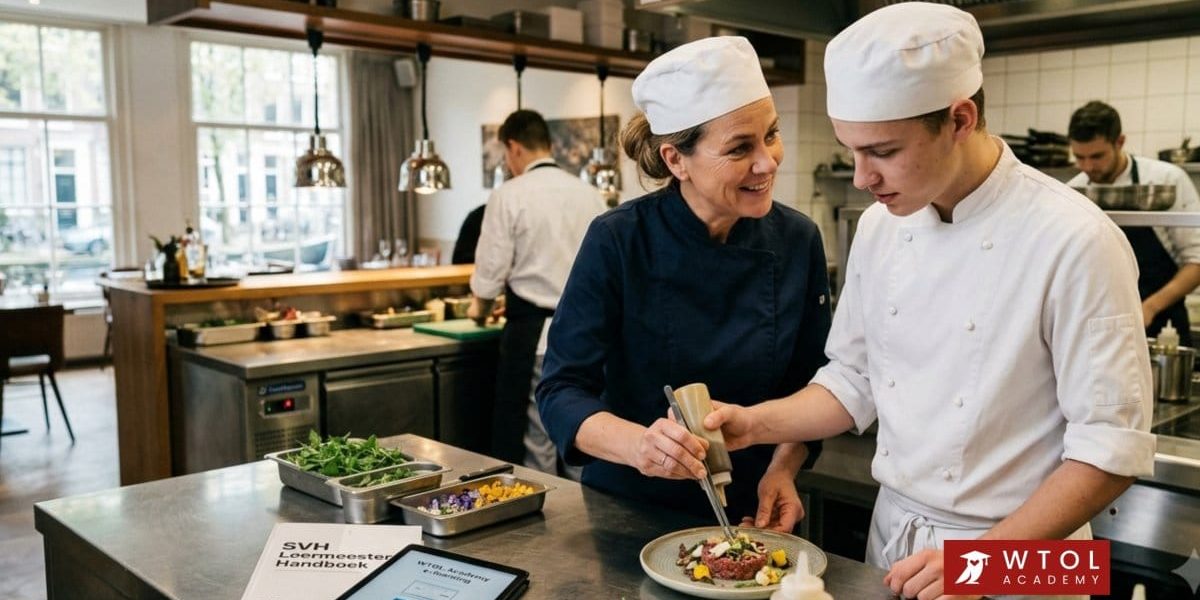
What if the solution to high staff turnover in your business doesn’t lie in a new recruitment campaign, but in the way you guide your current talent? Many entrepreneurs struggle with employees who don’t become independent quickly enough or feel they lack the didactic skills to effectively transfer their professional knowledge. It’s a recognisable problem: you have the passion and the knowledge, but transforming this into a structured learning pathway in the workplace is a skill in itself. A strong mentor in hospitality is the crucial link between an open vacancy and a loyal skilled professional.
In this article, you’ll discover how, as a mentor in hospitality, you can elevate your team and become a recognised master trainer. We’ll discuss how to hone your coaching skills so that new recruits are productive faster and enjoy their work more. Additionally, you’ll learn what’s required to achieve the official status of a recognised training company, including financial benefits such as the practical learning subsidy scheme, which could yield up to €2,800 per training placement in 2026. We’ll provide a clear overview of the path to mastery, from effective communication to successfully completing an official qualification with SVH.
Key Points
- Learn how to transition from simple onboarding to strategic mentorship to elevate your team.
- Discover which skills, such as active listening and empathy, are indispensable for a successful mentor in hospitality.
- Gain insight into how the status of a recognised training company acts as a quality mark and gives you access to a larger pool of motivated vocational students.
- Follow a clear step-by-step plan to obtain your official SVH Master Trainer diploma, including building a powerful digital portfolio.
- Experience how WTOL Academy’s flexible e-learning helps you effortlessly combine your professional development with daily hospitality practice.
What is a mentor in hospitality and why is this role crucial?
A mentor in hospitality is much more than an experienced colleague who simply shows where the ladles are or how the till works. It is a professionally mature guide who takes responsibility for the professional and personal growth of a team member. To understand what a mentor precisely entails, we need to look at the deeper layer of knowledge transfer. In Dutch hospitality, this role is often inextricably linked to the status of SVH Master Trainer. This isn’t just a title; it’s a quality mark that guarantees guidance meets national standards. Where simple onboarding stops at teaching tasks, strategic mentorship is about shaping a skilled professional who understands and embodies the spirit of hospitality.
The mentor safeguards the company’s standards. By guiding talent correctly, you ensure that the quality of service remains consistent, even during busy periods. This mastery requires a conscious choice for development. Do you want to formalise these skills? Then explore the various qualifications that will help you successfully take that step towards becoming a recognised master trainer.
The Difference Between a Manager and a Mentor
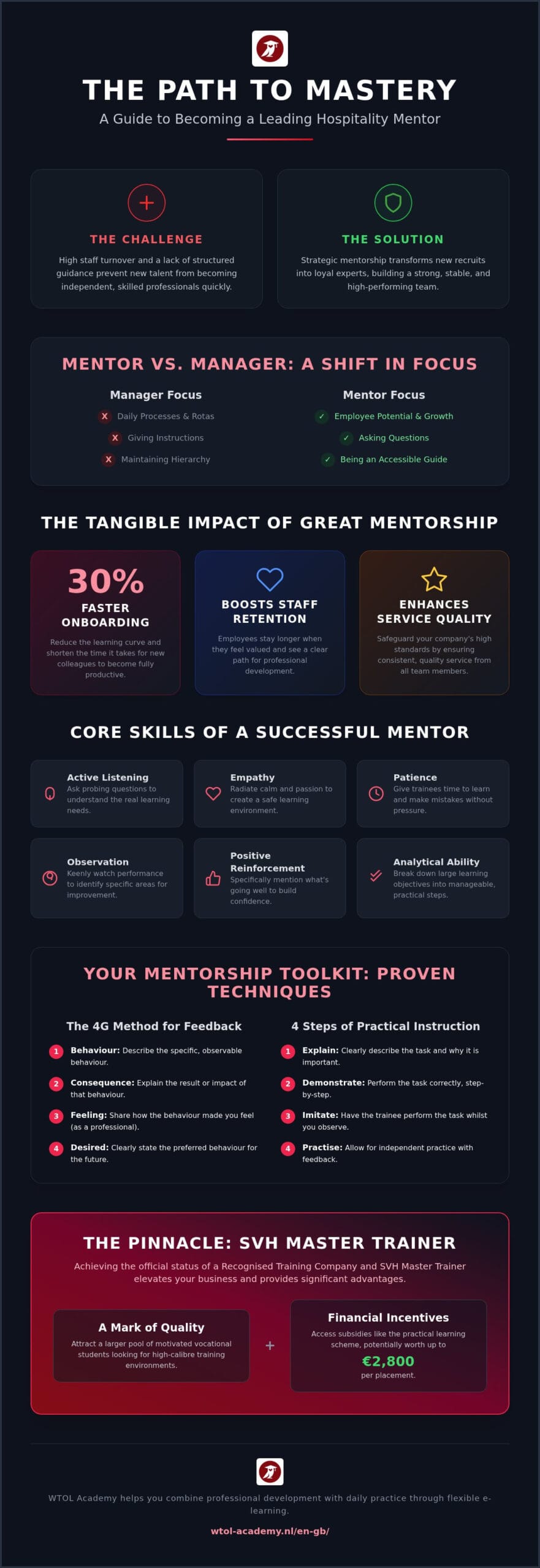
Managers often focus on the hard figures, rotas, and daily processes. A mentor, however, looks at the employee’s potential. It’s about shifting from giving instructions to asking questions. By adopting a coaching attitude, you help an employee find solutions for workplace problems themselves. You put on the mentor’s hat by standing alongside your protégé rather than above them. You maintain your authority through your expertise and professional knowledge, but you position yourself as an accessible guide. This approach creates a safe learning environment where making mistakes is allowed, as long as lessons are learned from them.
Mentorship as a Weapon Against Staff Shortages
In a tight labour market, investing in your people is the best strategy for retaining staff. Employees demonstrably stay longer with a company where they are given the opportunity to develop themselves and where their growth is taken seriously. A good mentor in hospitality ensures that a new colleague feels at home more quickly and masters the tricks of the trade faster. Experience in the sector shows that a structured mentorship programme can significantly shorten onboarding time, sometimes by up to 30 per cent. This reduces the workload for the rest of the team and directly increases the quality of your service. By creating a strong learning culture in your restaurant or hotel, you make your business a place where talent not only wants to work but also wants to continue growing.
The Most Important Skills of a Successful Hospitality Mentor
A good mentor in hospitality possesses keen observational skills and a generous dose of patience. It’s not just about transferring facts; it’s about understanding the person in front of you. Active listening forms the foundation here. By asking probing questions, you discover where the real learning need lies. Perhaps a new employee doesn’t find carrying a tray difficult, but interacting with a critical guest is the real hurdle. As a mentor in hospitality, you are the linchpin who recognises and removes these kinds of barriers.
Empathy is crucial. Do you remember your own first day? That overwhelming busyness and the fear of making mistakes? A mentor who radiates calm and shows passion for the profession creates a safe foundation. Whether it’s about the perfect preparation of a cocktail or enthusiastically talking about a local wine; your passion must be infectious. The mentor’s analytical ability then helps translate large learning objectives into manageable chunks in daily practice. Globally, the importance of structured guidance is recognised. For example, international reports emphasise that a recognised training company with a focus on craftsmanship is essential for a healthy sector.
Giving Effective Feedback in the Workplace
In hospitality, timing is everything. The 4G method (behaviour, consequence, feeling, desired behaviour) helps you keep feedback professional and constructive. Avoid in-depth conversations during peak hours; limit yourself to short, guiding instructions then. Save reflection for a quieter moment. Especially with young talent, positive reinforcement is the key to success. Specifically mention what’s going well; that provides the necessary self-confidence to tackle challenging tasks too.
Didactics for Practice: From Demonstrating to Doing It Yourself
Use the four steps of practical instruction: explain, demonstrate, imitate, and practise. Take, for example, presenting wine at the table. This is a complex task that you can best break down into sub-goals. Start with the basic knowledge from SVH Wine 1. First, show how to present the bottle, then how to remove the cork, and finally how to let the guest taste. By practising these steps separately, the trainee won’t be overwhelmed. Do you want to grow in this role yourself? You can start immediately with one of our professional training courses to elevate your coaching skills.
Why Every Hospitality Business Wants to Be a Recognised Training Company
Achieving the status of a recognised training company is a milestone for many entrepreneurs. It’s an official quality mark that projects your business as a place where craftsmanship is nurtured and passed on. To gain this recognition from the SBB (Cooperation Organisation for Vocational Education, Training and the Labour Market), it is a strict requirement that at least one certified master trainer is present in the workplace. This mentor in hospitality serves as the anchor point for the training of new talent and safeguards the company’s standards.
Besides the honour and quality image, there are concrete financial benefits that support your company’s growth. The Dutch government encourages the training of vocational students through the Practical Learning Subsidy Scheme. For the academic year 2025-2026, the application period runs from 2 June 2026 to 17 September 2026. The maximum subsidy per recognised training placement can amount to €2,800. This amount is a welcome reimbursement for the costs of the time and energy you invest in guidance. It’s an investment that pays for itself many times over; in money, but especially in the quality of your future workforce.
Furthermore, as a recognised training company, you gain access to a huge pool of motivated trainees. Annually, approximately 500,000 vocational students in the Netherlands are trained by recognised training companies. By positioning yourself as an educator, you attract students who consciously choose the profession and are eager to learn the finer points of hospitality from an experienced guide.
Attracting and Retaining Young Talent
Generation Z views work differently from previous generations. For them, a job isn’t just about the salary, but primarily about meaning and personal development. They seek a mentor in hospitality who not only tells them what to do but also inspires them to improve. A mentor creates a safe learning environment where young talent dares to experiment and learns from mistakes. As a mentor, you are the most important ambassador for your company culture. You show what makes your business unique and why it’s worthwhile to build a career here.
Quality Assurance for Your Service
Another major advantage of structured mentorship is the standardisation of your processes. Without clear guidance, you often see employees adopting their own habits or picking up "incorrect" mannerisms from colleagues. This ultimately detracts from the guest experience. Through clear instruction and coaching, you ensure that every guest experiences the same high standard, regardless of who is serving. Do you want to perfect the table service? The host / hostess qualification offers the perfect in-depth training to elevate your team to a professional level and guarantee quality in your business.
The Path to Your Official SVH Master Trainer Diploma
Obtaining your SVH diploma is the crowning achievement of your work as a mentor in hospitality. The programme is designed not only to test your theoretical knowledge but also to assess how you transfer that knowledge to the next generation. With a national pass rate between 88 and 96 per cent, it is an achievable goal for every motivated professional. The process consists of a number of logical steps that guide you step-by-step towards mastery.
- Step 1: Enrolment. Choose a recognised master trainer course that aligns with your practical experience.
- Step 2: The Digital Portfolio. Here you gather evidence of your skills as a guide.
- Step 3: Theory Examination. This component tests your knowledge of didactics, coaching, and relevant legislation.
- Step 4: The Practical Examination. You conduct a so-called learning conversation with a trainee, during which an examiner observes your coaching techniques.
- Step 5: Registration. After your successful examination, you will be included in the official SVH register.
This diploma is more than just a piece of paper; it grants you the official authority to guide vocational students within a recognised training company. The programme compels you to critically examine your own communication style. Do you want to take on this challenge and boost your career? You can start immediately with the SVH Master Trainer qualification to set your journey in motion today.
Tips for a Winning Portfolio
Start immediately with collecting evidence in the workplace. Don’t wait until the last minute, but take photos of instruction moments and keep completed assessment forms. A common mistake is that learning plans remain too vague. Ensure SMART goals that are crystal clear for both the trainee and the examiner. The more concretely you can demonstrate that a trainee has grown through your intervention, the stronger your portfolio will be.
Preparing for the Learning Conversation
The practical examination ‘Coaching & Guidance’ revolves around interaction. Practise this with role-playing games with your own colleagues. Find the balance between directing when necessary and coaching where possible. A calm setting without distractions is essential to truly get to the core of the learning process. Reflection after each practice conversation is the most powerful way to discover and improve your own blind spots as a mentor.
Start Your Journey as a Mentor with WTOL Academy
You don’t have to take the step towards mastery alone. A strong mentor in hospitality also needs an experienced guide to show the way in the educational landscape. At WTOL Academy, we understand that hospitality practice is unpredictable and that your time is precious. That’s why our approach is fully tailored to the needs of busy professionals. We combine our passion for hospitality with structured didactics that are directly applicable to your own workplace. Our instructors are not theorists far removed from practice; they are people who have themselves been in the thick of it and know exactly what’s needed to enthuse a team.
Whether you run a small family business or are responsible for talent management in a large hotel; the right guidance makes all the difference. By choosing a specialist who speaks the industry’s language, you ensure a smooth transition from skilled professional to master trainer. View our full range of hospitality qualifications to see how we can support you at every step of your professional growth.
Flexible Learning with Our E-learning Modules
Spending days in classrooms isn’t an option for most hospitality professionals. Our e-learning modules offer the perfect solution. You study at your own pace, wherever and whenever suits you. The modules are interactive and filled with videos that translate theory into recognisable situations in your own business. With our practice exams, you’ll prepare optimally for the SVH assessment, so you can approach the examination with confidence. Don’t forget that a good foundation is essential; many mentors choose to first refresh their knowledge of social hygiene before embarking on the master trainer programme. This diploma is often a prerequisite for official recognition.
Why Choose an SVH-Accredited Qualification?
Quality is paramount for us. When you choose an SVH-accredited qualification with WTOL Academy, you opt for the assurance of a nationally recognised diploma. In the hospitality sector, this serves as an important quality mark; it demonstrates that you meet the highest standards of professional competence. Furthermore, you are assured that the course material is always up-to-date. We incorporate the latest legislation and the most recent didactic insights directly into our curriculum. This is not only beneficial for your own development, but it also sends a powerful signal to your trainees and future interns. Sign up today and become the mentor in hospitality your team deserves; an inspiring leader who not only shares knowledge but also ignites the passion for the profession.
Build the Future of Your Team and Craftsmanship
The success of your hospitality business hinges on the quality and commitment of your team. By taking the role of mentor in hospitality seriously, you transform the workplace into a place where talent is not only utilised but truly flourishes. You’ve seen how to apply didactic skills to ensure service quality and how the path to an official SVH diploma underscores your professionalism. Investing in your own coaching skills is the most sustainable way to address staff shortages and create a culture of mastery.
At WTOL Academy, we are ready to guide you in this. As an SVH-accredited training institute with national coverage, we offer the flexibility you need in hospitality. Our students rate our approach with an average of 9 or higher, and for good reason. Whether you choose our interactive e-learning or a physical training course on-site; you will always be taught by experts who breathe passion for hospitality and know what’s happening in the workplace.
Take the next step in your career today and strengthen the future of your company. View our qualifications and become a recognised mentor. We look forward to helping you elevate your team and pass on your passion for the profession to the next generation.
Frequently Asked Questions About Mentorship in Hospitality
What is the difference between a mentor and a master trainer in hospitality?
In practice, these terms are often used interchangeably, but there is a formal difference. A mentor in hospitality is the role you fulfil in the workplace as a guide and coach, whilst master trainer is the official title you receive after obtaining the SVH diploma. Without this diploma, you cannot call yourself a recognised master trainer and cannot officially guide vocational students within a recognised training company.
Is a mentor qualification mandatory for every hospitality business?
A mentor qualification is not legally mandatory for every business, but it is necessary if you want to become a recognised training company. To be allowed to train vocational trainees, the SBB requires that at least one certified master trainer is present in the business. Additionally, the training helps you reduce staff turnover and maintain the quality of your service at a consistently high level.
How long does the programme take to become a recognised mentor?
The programme to become a recognised mentor is relatively short and intensive. Most students follow a training course of three or four days, spread over several weeks. Besides these course days, you spend time building your digital portfolio and preparing for the theory examination. Depending on your own pace and the available examination dates, you can be fully qualified within two to three months.
Can I complete the mentor qualification entirely online?
You can now complete the preparation for mentorship entirely online via modern e-learning modules. This is ideal for busy professionals who want to study at times that suit them. However, bear in mind that the official SVH examinations, such as the practical component of coaching and guidance, always take place at a physical location to assess your skills in a real-world setting.
What prior qualification do I need to become a mentor in hospitality?
There is no specific prior qualification required to start the qualification to become a mentor in hospitality. However, it is important that you possess sufficient professional knowledge and practical experience in your own field, also known as professional maturity. Additionally, holding the Social Hygiene diploma is a requirement to be registered as a recognised master trainer in the official SVH register.
What are the costs of an SVH Master Trainer examination?
The total examination costs for the SVH Master Trainer diploma in 2026 amount to €310. This amount covers the three mandatory components: the assessment of your digital portfolio, the theory examination, and the practical examination in coaching and guidance. If you need to retake components separately, different rates apply, such as €228 for the practical examination when booked individually with the examination institution.
How does a mentor help with onboarding new staff?
A mentor structures the onboarding process by breaking down complex tasks into manageable sub-goals. Instead of throwing a new employee straight in at the deep end, you work with a targeted learning plan. This creates a safe learning environment where mistakes are seen as valuable learning moments. As a result, employees are onboarded up to 30 per cent faster and immediately feel more connected to your company culture.
What should a portfolio for the mentor qualification minimally contain?
In your portfolio, you gather tangible evidence of your qualities as a guide. This minimally includes a number of elaborated learning plans, reports of learning conversations, and completed assessment forms from your trainees. The goal is to demonstrate to the examiner that you are capable of systematically tracking a student’s growth and making adjustments where necessary to achieve the learning objectives.