
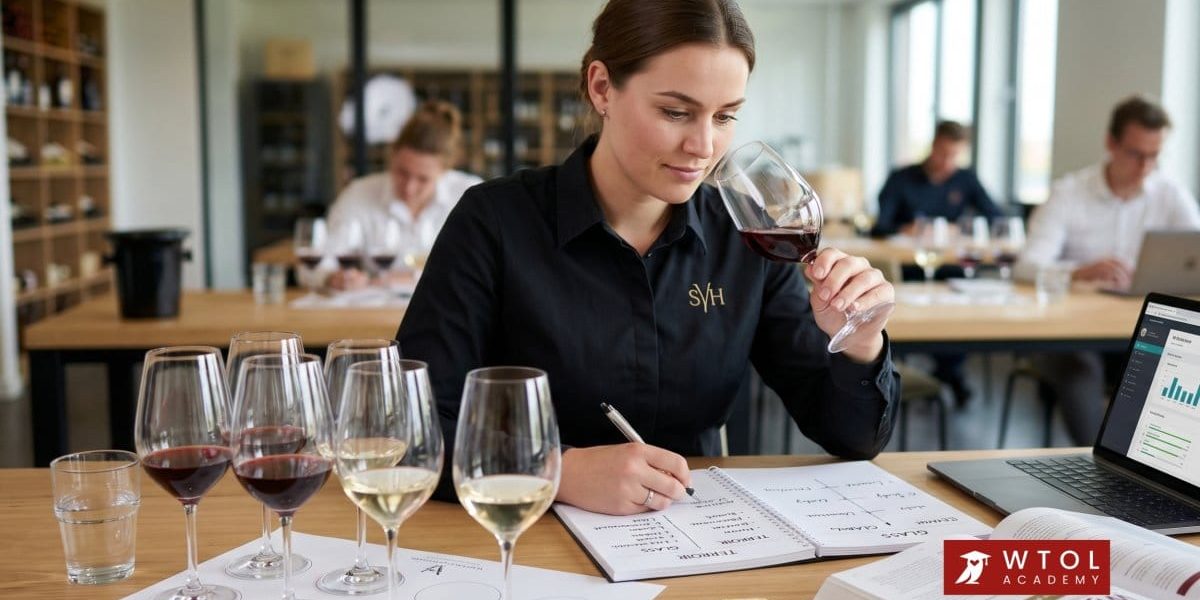
Did you know that successfully completing your SVH Wine Certificate has less to do with simply cramming facts and more with understanding the relationship between terroir and glass? Thorough SVH Wine Certificate exam preparation requires a smart approach where theory and practice converge. It’s perfectly logical that the enormous amount of information on wine legislation and the uncertainty of blind tasting can sometimes discourage you. Perhaps you even wonder what exactly the difference is between SDEN 3 and the SVH certification.
Don’t worry, because we’re here to help you work towards your exam with complete focus and passion. In this article, you’ll discover the most effective strategies and tips to optimally prepare for both the theory and the challenging tasting component. We’ll discuss a structured study plan and provide you with the tools needed for confidence in analytically determining wines. After reading, you’ll know exactly how to achieve that coveted, officially recognised title for your further career in hospitality.
Key Points
- Understand the crucial difference between SDEN 3 and the SVH exam and why this qualification is the gold standard for hospitality professionals.
- Discover how to effectively structure complex wine legislation and regions from the Old and New World into a clear study plan.
- Learn a systematic method for analytical tasting, which is an essential part of good SVH Wine Certificate exam preparation.
- Get practical tips for time management and mental calm during the theory questions and blind tasting on exam day.
- Discover how the unique combination of e-learning and practical lessons increases your chances of passing and prepares you for a role as a wine expert.
What is the SVH Wine Certificate and why is good preparation essential?
The SVH Wine Certificate is the official proof of professional competence at Level 3. For the ambitious hospitality professional, this qualification is the gold standard. Thorough SVH Wine Certificate exam preparation is essential here, as the bar is set high. Where previous levels focused on the basics, this level compels you to truly embrace the complexity of the wine world. You’ll not only learn about grapes but will soon understand the full context of the sector.
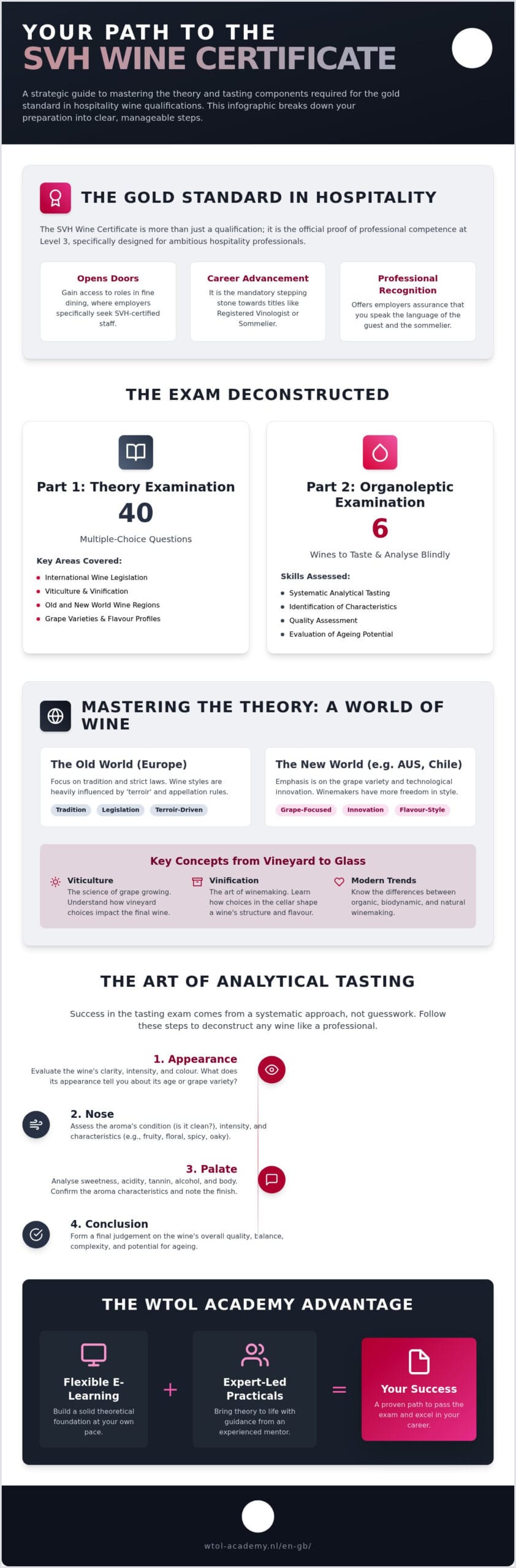
Many students hesitate between SDEN 3 and the SVH pathway. Whilst both forms of training are valuable, SVH certification is specifically designed for the hospitality sector. The exam not only tests whether you know facts but also whether you can apply them in a professional setting. The structure of the exam directly reflects this. You’ll face 40 challenging multiple-choice questions on theory and an organoleptic component where you must analytically assess six wines. It’s a tough test that demands dedication.
The Value of the Qualification in Dutch Hospitality
This qualification opens doors that would otherwise remain closed. It is the mandatory stepping stone for anyone who ultimately aspires to the title of Registered Vinologist or Sommelier. In practice, we see that employers in fine dining specifically ask for SVH-certified staff. It offers them the assurance that you speak the language of the guest and the sommelier. At the courses at WTOL Academ , this recognition is central. You are not just trained for a piece of paper, but for a brilliant career where your expertise makes the difference at the table. You immediately distinguish yourself from the crowd.
The Transition from Basic Knowledge to Advanced Level
Knowing that a wine is fruity is no longer sufficient at Level 3. You must now be able to explain why that wine has these specific characteristics. This requires in-depth insight into the science of winemaking. You study how the winemaker’s choices and specific terroir characteristics influence the wine’s structure. The shift to international wine legislation and complex classifications demands a structured approach. It’s about understanding causal relationships rather than just memorising names.
Good SVH Wine Certificate exam preparation revolves around making these connections. At WTOL Academy, we therefore use a method where flexible e-learning lays the theoretical foundation, whilst practical lessons led by an experienced mentor bring the material to life. You learn to taste systematically: from appearance and aroma to the final conclusion about quality and ageing potential. This analytical skill is precisely what distinguishes the professional from the enthusiast. It is a transformation from passion to profession.
Preparing Theory: Focus on Wine Legislation, Vinification, and Regions
The theoretical basis of the Wine Certificate goes deep. During your SVH Wine Certificate exam preparation, you’ll discover that the world is roughly divided into the Old World and the New World. In Europe, the Old World, everything revolves around tradition and strict legislation per appellation. Think of the complex classifications in Bordeaux or the cru systems in Burgundy. In the New World, such as Australia and Chile, the focus is often more on the grape itself and technological innovation. The exam tests whether you understand these fundamental differences and can link them to specific flavour styles.
Focus areas such as Germany and Austria are gaining ground in the current exam material. You must know German Prädikatsweine inside out and understand how the Austrian DAC structure works. Terroir plays a major role here. The influence of a cool climate on the acidity of a Riesling or the impact of slate on minerality is a common feature in the questions. The point is not just to read the theory, but to visualise it as a flavour map.
Study Method for International Wine Legislation
Knowledge of Viticulture and Vinification
The choices in the vineyard (viticulture) and the cellar (vinification) determine the final result in the glass. You must not only be able to define terms like malolactic fermentation and oak ageing, but also explain their influence on the taste. Malolactic conversion, for example, makes a wine creamier and softer, whilst new oak adds aromas of vanilla and toast. Every conscious choice made by the winemaker in the cellar forms a direct blueprint for the ultimate flavour profile and structure of the wine.
Nowadays, there is also much attention paid to sustainability and organic viticulture. The exam expects you to know the difference between organic, biodynamic, and natural wines. This kind of up-to-date knowledge completes your SVH Wine Certificate exam preparation. Do you really want to master this theory? Then take a look at the courses at WTOL Academy, where we translate this complex material into understandable and applicable knowledge for practice.
Analytical Tasting for the Exam: A Systematic Approach
The tasting component is the most exciting part of the assessment for many students. However, during your SVH Wine Certificate exam preparation, you’ll discover that tasting is not a matter of luck or an innate talent, but of an ironclad system. The Hospitality Competence Foundation (SVH) uses a strict methodology where you objectively dissect each wine. You start with the appearance: is the wine clear and what does the colour intensity say about its age or grape variety? Then you analyse the aroma for purity, intensity, and specific aroma groups such as fruit, herbs, or oak notes.
In the mouth, it’s all about structure. You assess the dryness, acidity, alcohol, and for red wines, the tannins. Recognising quality characteristics is crucial here. A good wine distinguishes itself by a perfect balance between these elements, a high flavour intensity, and a significant length or finish. The longer the pleasant taste lingers, the higher the quality often is. By systematically noting these steps, you build a body of evidence that almost automatically leads you to the correct grape variety or region. Blind determination thus becomes a logical puzzle instead of a guess.
Building a Sensory Memory
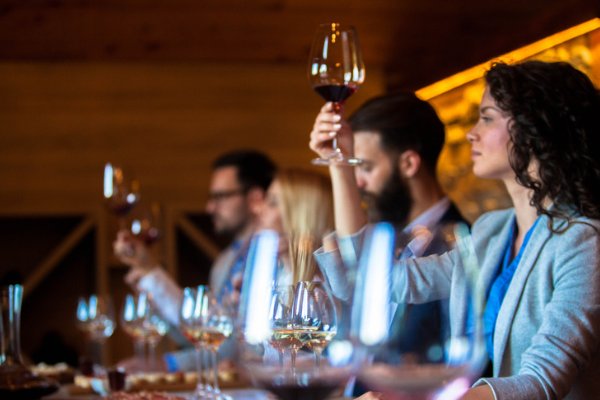
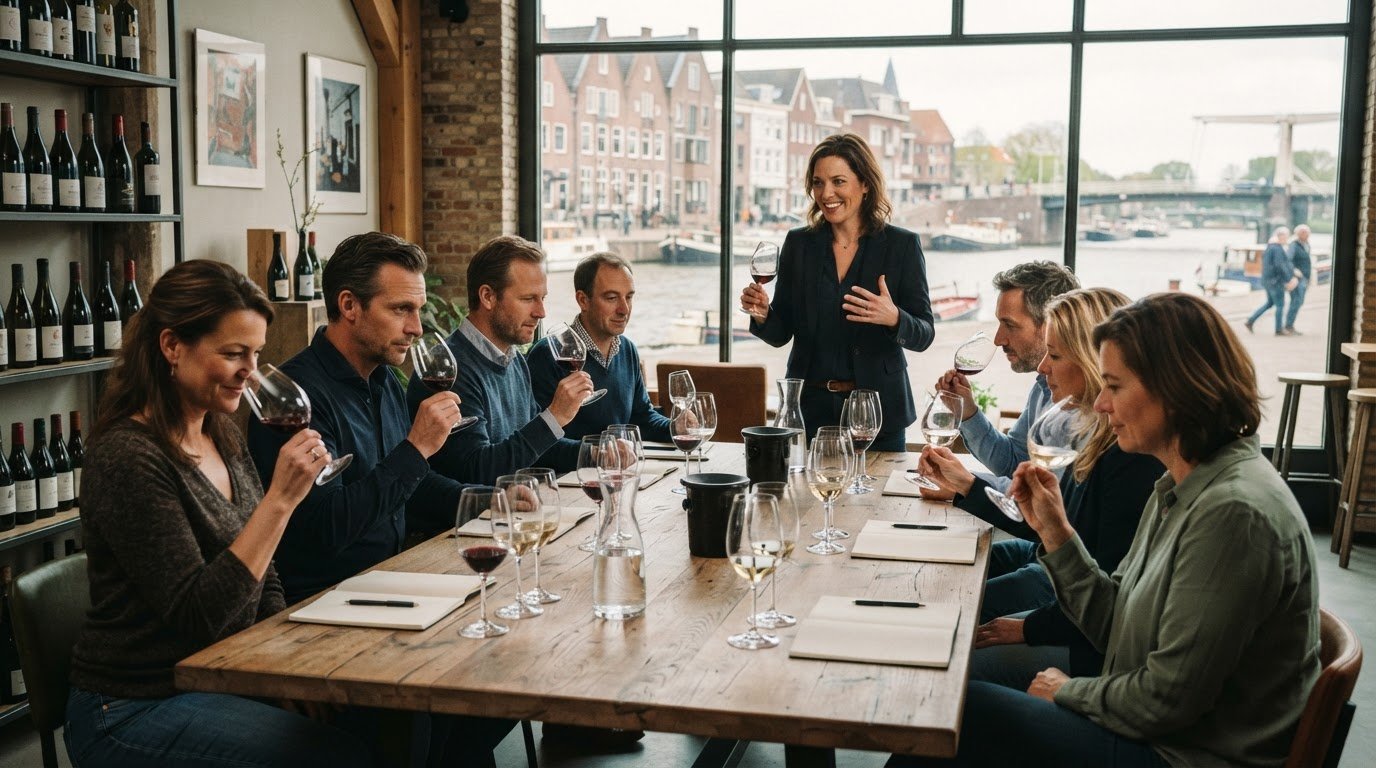
Training your sense of smell and taste buds requires regularity. Consciously tasting every day, even during a simple meal, is more effective than visiting one large tasting once a month. Use aroma wheels and official tasting forms to standardise your observations. The physical meetings at the courses at WTOL Academy are invaluable here. You taste alongside experts and fellow students, allowing you to directly calibrate your sensory interpretations against the standard. This significantly accelerates the development of your sensory memory.
Common Mistakes in the Tasting Component
The biggest pitfall is wanting to guess too quickly which wine is in the glass. Students often immediately name a grape variety, only to then make their analysis fit that preconception. Stay objective and trust your observations. Another common mistake is confusing acidity with tannins. Remember that acidity causes salivation on the sides of your tongue, whilst tannins give a rough, drying sensation on your gums and palate. During your SVH Wine Certificate exam preparation, it’s also smart to neutralise your palate with water or a plain cracker between wines. This keeps your perception sharp until the last sip.
Strategy for Exam Day and Tactical Tips
The day of truth has arrived. You’ve studied regions for weeks and systematically learned to taste. Now it’s about focus and calm. Good SVH Wine Certificate exam preparation doesn’t stop at the subject matter; it’s also about how you perform under pressure. The theory exam for SVH Wine 3 consists of 40 multiple-choice questions. Whilst this seems like ample time, strict time management is essential to avoid running out of time on trickier questions about vinification or legislation.
The psychology of the tasting component is at least as important. When six unknown wines are in front of you, doubt can sometimes strike. Stay calm. Trust the analytical steps you’ve trained. The exam is not a guessing game, but an objective observation. Read each question three times. Trick questions often lie in small words like ‘not’ or ‘always’. By staying calm and dissecting the question accurately, you prevent unnecessary mistakes that could cost you.
Effectively Handling Multiple-Choice Questions
Are you unsure about a specific region or vintage? Then immediately apply the elimination method. Cross out the answers you are sure are incorrect. Often, two options remain, increasing your chance of a correct answer to 50 per cent. For questions about wine-food pairings, it’s smart to reason logically from the basic tastes: fat calls for acidity or tannins, whilst sweetness in the dish calls for an even sweeter wine. Moreover, trust your first instinct. Statistics show that students more often change their answer from correct to incorrect than vice versa. Only change your choice if you find solid evidence in the theory.
The Last 24 Hours Before Your SVH Exam
The evening before the exam is not the time for a heavy meal or a late-night cramming session. Your brain needs rest to process all the information. Ensure a good night’s sleep; a fresh brain performs better than a tired brain crammed with last-minute facts. Also, pay attention to your senses. Avoid spicy foods like peppers or garlic and don’t drink strong coffee just before the tasting component. This affects your palate and your sense of smell. On the day itself, also avoid using perfume or strong aftershave, as this hinders not only you but also your fellow students in smelling the wines.
Do you want even more practical tools? Then check out these 5 tips to pass your SVH exam for additional tactics that can give you that extra push. Your SVH Wine Certificate exam preparation is only truly complete if you are also mentally optimally prepared. Are you ready to secure that official recognition? Enrol in one of the courses at WTOL Academy and enter the exam room with maximum confidence.
Your Path to Success at WTOL Academy
You don’t have to walk the path to obtaining your qualification alone. Effective SVH Wine Certificate exam preparation begins with the right guidance and an inspiring learning environment. At WTOL Academy, we believe in the power of the master-mentor. Our lecturers have completed the highest wine training themselves and bring years of practical experience to the teaching location in Woerden. This ensures that the theoretical material from the books is directly linked to the reality of the workplace, allowing you to retain the knowledge faster and better.
Our academy’s unique approach combines the flexibility of e-learning with the depth of physical practical lessons. Whilst you study the theory of wine regions and legislation online at your own pace, you use the meetings to sharpen your senses. This hybrid form of education is not only efficient but also ensures an enjoyable learning experience. The result speaks for itself: no less than 98% of our students recommend the academy. We understand that learning is an opportunity for personal enrichment and we do everything we can to professionalise your passion for wine.
Why Choose a Professional Training Institute?
Self-study has its limits, especially in a field that relies so heavily on sensory perception. At a professional institute, you gain access to high-quality tasting wines that are representative of what you can expect on the exam. You learn not only from the lecturer but also from the observations of your fellow students. Jointly discussing a complex Bordeaux or a crisp Riesling helps you to calibrate your own palate. Furthermore, we work closely with SVH, ensuring that our courses seamlessly align with national quality standards. So you can be sure that you acquire precisely the knowledge needed to pass.
Enrol in the SVH Wine 3 Course
Are you ready to take the next step in your career? The SVH Wine 3 course (Wine Certificate) is the ideal preparation for the official exam. Our interactive e-learning module helps you structure the maze of international legislation, whilst the practical lessons prepare you for analytical tasting. For those who wish to grow further after obtaining the Wine Certificate, we offer a direct path to the prestigious vinologist training. View our current range of start dates and locations and start your Wine Certificate preparation today. Together, we will ensure that you achieve your qualification with confidence and professional competence.
Ready for the Next Step in Your Wine Career
You now know that successful SVH Wine Certificate exam preparation revolves around the right balance between theoretical insight and a systematic tasting method. We have unravelled complex wine legislation and discussed concrete tactics to enter the exam room with confidence. By linking the theory from books to practice in the glass, you lay a solid foundation for your further career in hospitality.
As an SVH-accredited training institute, WTOL Academy is ready to help you with this. Our unique learning method ensures a high pass rate, where you benefit from personal guidance by experienced registered vinologists. View all SVH wine courses and start immediately professionalising your passion. You now have the knowledge and tools at your fingertips. Take that step today and become the expert your guests deserve.
Frequently Asked Questions about the SVH Wine Certificate
What is the difference between SDEN 3 and the SVH Wine Certificate?
The SVH Wine Certificate is specifically developed for the professional hospitality sector, whilst SDEN 3 is more often used by consumers or in the wine trade. SVH is considered the gold standard for professional competence at Level 3 in Dutch hospitality. The qualification is widely recognised by employers in fine dining and is the official gateway to prestigious further training such as vinologist or sommelier.
How much time should I allow for exam preparation?
On average, you’ll need six to eight weeks for thorough SVH Wine Certificate exam preparation. This period is used to delve into the theoretical material on international wine regions and legislation and to train your sensory skills. By scheduling weekly time for both interactive e-learning and systematic tasting, you’ll build the necessary routine to approach the exam with confidence.
Is the tasting component of the Wine Certificate very difficult?
The tasting component is challenging because it requires an objective, analytical approach rather than simply guessing a grape. You assess six wines based on appearance, aroma, and taste according to a strict framework. However, with the right training and a systematic approach, this component is manageable for anyone willing to practise seriously with representative wines.
Can I take the SVH Wine Certificate exam without a course?
Yes, it is technically possible to register directly with SVH for the exam, but the chances of passing are significantly lower. Without the feedback of an experienced mentor and access to a wide range of tasting wines, it’s difficult to meet the required standard. A professional course provides the necessary context and practical experience that you cannot gain from a textbook alone.
Which books do I need for the SVH Wine 3 exam?
The official SVH Wine 3 textbook forms the basis of all exam material. It extensively describes all relevant topics such as viticulture, vinification, and the world’s most important wine regions. At WTOL Academy, we supplement this book with a modern e-learning module that translates complex theory into visual diagrams and practice questions for your SVH Wine Certificate exam preparation.
What happens if I fail one of the components?
The exam consists of two separate components: a theory exam with multiple-choice questions and an organoleptic tasting exam. Should you fail one of the two components, you only need to retake that specific part. You retain your positive result for the section you passed, allowing you to fully focus on your weaker area during a resit.
How long is the Wine Certificate qualification valid?
An obtained SVH Wine Certificate qualification is valid indefinitely. It is a lifelong proof of your professional competence and in-depth knowledge of the wine world at Level 3. Although the document itself does not expire, we advise professionals to keep their knowledge current through masterclasses, as the wine world and its associated legislation are constantly evolving.
What is the next level after obtaining the Wine Certificate?
After successfully completing the Wine Certificate, the logical next step is the SVH Wine 4 level. This pathway leads to the title of vinologist or sommelier and is the highest professional level in the Netherlands. With this, you deepen your knowledge to the smallest details of terroir and vinification, offering you the opportunity to eventually register as a Registered Vinologist.