


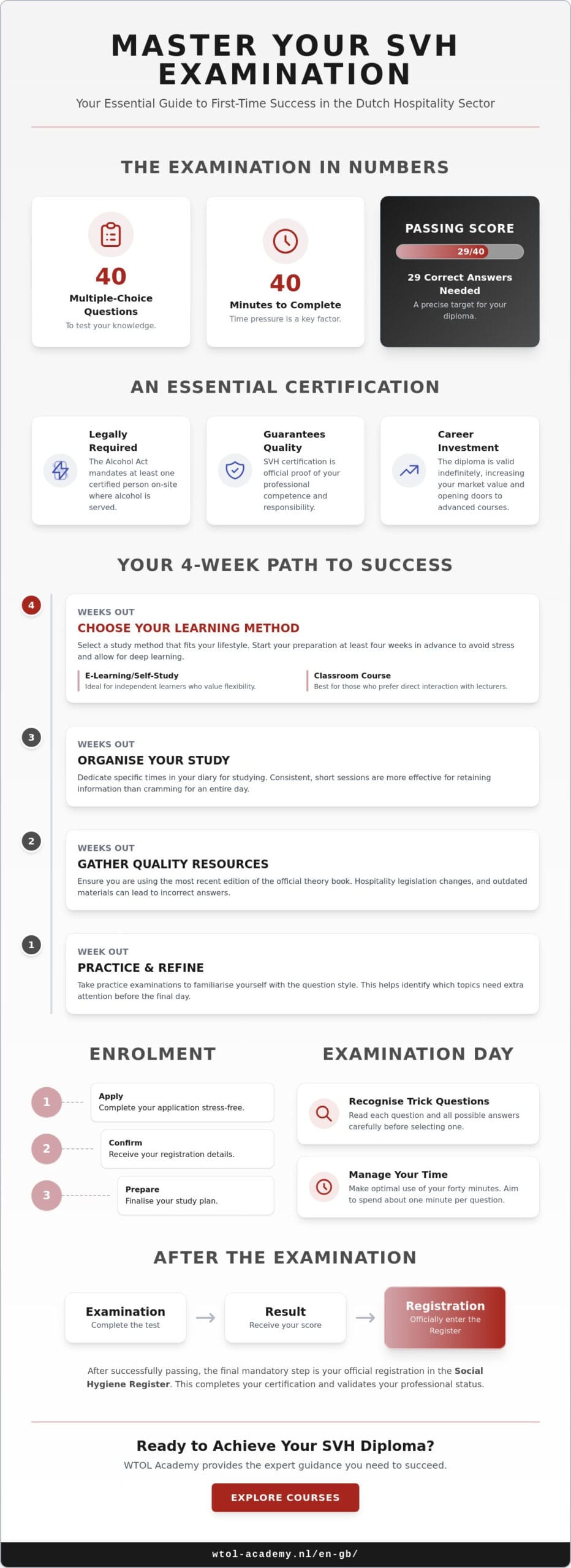
Did you know that for the SVH examination, you need to answer exactly 29 out of 40 questions correctly to obtain your diploma? It might seem like a small margin, but the time pressure of forty minutes often causes talented hospitality professionals to encounter unnecessary difficulties. It’s perfectly understandable that you might dread the investment and the uncertainty about the difficulty of the questions, especially when your passion lies more with practical work than with textbooks.
You don’t just want to get a piece of paper; you want to grow in your profession without the fear of failing an official examination. In this guide, you’ll discover exactly what you need to know, do, and arrange to pass your SVH examination first time. We offer you a clear step-by-step plan for your studies, explain precisely how enrolment and registration work in 2026, and clarify the different types of diplomas available. This way, you’ll begin your preparation with complete focus and mastery.
Key Points
- Understand the legal necessity of certification within the Alcohol Act and the role of the Stichting Vakbekwaamheid Horeca (Hospitality Competence Foundation) as a quality guardian.
- Discover how a minimum preparation time of four weeks and the correct learning method significantly increase your chances of success for the SVH examination.
- Gain clarity on the practical enrolment procedure and current costs, so you can complete your application without stress.
- Learn specific examination techniques to recognise trick questions and make optimal use of your time during the forty-minute assessment.
- Gain insight into the mandatory final step: official registration in the Social Hygiene Register after achieving your result.
Table of Contents
What is an SVH Examination and Why is it Essential?
Anyone working in the Dutch hospitality sector will, sooner or later, encounter the Stichting Vakbekwaamheid Horeca (SVH) (Hospitality Competence Foundation) . This organisation functions as the central quality institute that monitors standards for craftsmanship and hospitality in our country. Taking an SVH examination is for many professionals the first serious step towards a brilliant career. It is, in fact, much more than a theoretical test; it is official proof that you master the intricacies of the profession and can bear the responsibility that comes with working in a dynamic hospitality environment. Whether you aspire to run a Michelin-starred restaurant or wish to provide the perfect evening as a host, this certification forms the foundation of your professional identity.
The necessity of these diplomas is deeply rooted in Dutch legislation. The Alcohol Act, for example, stipulates that in every establishment where alcohol is served or sold, there must always be at least one person present who holds the Social Hygiene diploma. Without this certificate, an entrepreneur risks heavy fines or even the closure of the business by the municipality. The diploma is valid indefinitely, making it one of the most valuable investments in your own career. It demonstrates that you understand how to deal with alcohol moderation, gambling, and social behaviour in the workplace, which is essential for a safe and welcoming environment.
The Most Common SVH Examinations
The Value of an Official Certificate
An official diploma immediately increases your market value within the sector. Employers are constantly looking for people who can demonstrate their competence in black and white, as this gives them the assurance that they meet the strict requirements of the Dutch Labour Inspectorate. Furthermore, a successfully completed examination opens the door to prestigious next steps, such as the Vinologist course for those who truly wish to distinguish themselves in the world of wine. Obtaining your certificate is therefore not just a mandatory formality, but an opportunity for personal enrichment and proof of mastery that you carry with you for the rest of your life.
Your Checklist for Optimal SVH Examination Preparation
Success in the SVH examination is not a matter of luck or chance. It is the result of robust planning and the correct study method. Many candidates make the mistake of only opening their books in the last week before the examination date. This causes unnecessary stress. Therefore, start gathering your study materials at least four weeks in advance. This period gives your brain time to truly process complex legal frameworks and technical professional details. After all, the goal is not just to obtain a piece of paper, but to enhance your professional competence in the workplace.
The first step in your preparation is choosing a learning method that suits your lifestyle. Do you prefer to work independently at your own pace? Then e-learning or self-study is ideal. However, if you need direct interaction and practical examples from an experienced lecturer, then opt for a physical lesson day. Whichever form you choose, schedule fixed study times in your diary. Spread the material over several short sessions instead of cramming for an entire day. This keeps your focus sharp and prevents the large amount of theory from overwhelming you. It’s smart to take practice examinations at the end of each study week. This way, you become accustomed to the foundation’s specific questioning style and discover in good time which topics still require extra attention.
Selecting Study Materials and Resources
Quality over quantity is the motto when selecting your resources. Always use the most recent edition of the theory book; hospitality legislation changes regularly, and outdated information can cost you valuable marks. For those specifically focused on the wine world, the SVH wine diploma guide offers an essential overview. Additionally, consult the official SVH website for the most current examination requirements and learning objectives. Interactive online learning environments are often a good supplement, as they provide immediate feedback on your mistakes.
Effective Learning for Hospitality Theory
Whilst studying, focus on the core concepts that always reappear in the SVH examination. These include the Alcohol Act, regulations surrounding gambling, and the social skills required for difficult situations with guests. Use flashcards for memorising definitions and legal deadlines; this is a proven method for quickly recalling factual knowledge. Furthermore, apply the theory directly in practice. During your next shift, observe how your colleagues handle age checks or how the kitchen’s workflow is organised. By visualising the material in your own work environment, the theory becomes more vivid and easier to remember. Do you want to ensure you lay the right foundation? You can always view our current courses for professional support with your studies.
Taking a Digital Examination (CBT)
Nowadays, most assessments are conducted via Computer Based Testing (CBT). This is an efficient method where you answer 40 multiple-choice questions on a screen in a secure environment. You are given exactly 40 minutes for this. The biggest advantage of this digital format is its speed; you see immediately after completing the last question whether you have passed. The interface is simple and clear, so you are not distracted from the content. You can mark questions to revisit them later, which helps maintain an overview during time pressure.
Requirements for Examination Day
Without a valid form of identification, you will not be allowed into the examination room. This is a strict rule for which no exceptions are made by the invigilators. Also, ensure you have your enrolment confirmation letter to hand; this can be digital on your phone or printed on paper. Time management is crucial for a calm start to your SVH examination. Arrive at the location at least 15 minutes before the start. This gives you the necessary time to register and safely store your personal belongings in a locker. Good preparation on the day itself is half the battle. Do you want to put the finishing touches? You can always view our courses for the latest examination tips and professional guidance.
Tips for Examination Day: How to Achieve That Coveted Score
The day of the SVH examination has arrived. You have studied for weeks and the theory is in your head, but now it comes down to execution in the examination room. The biggest pitfall for many candidates is haste. Although forty minutes seems short for forty questions, in practice, you have exactly one minute per question. That is ample time if you remain calm and adopt a methodical approach. A golden rule is to read each question at least twice before selecting an answer. The nuance often lies in a single word that can completely change the full context of a legal or social situation.
The foundation is known for its ‘trick questions’ in the phrasing. Therefore, pay extra close attention to words such as ‘never’, ‘always’, or ‘except’. These terms often make a statement too absolute or completely reverse the logic of a question. If you overlook these, you will quickly choose an incorrect answer, even if you have an excellent grasp of the basic material. Also, make clever use of the software. If you are unsure about a specific part, do not dwell on it for too long. Use the mark function to temporarily skip the question and move on to the next. Often, the correct insight will come to you later, or you may encounter a hint in another question that refreshes your memory.
Dealing with Multiple-Choice Questions
With multiple-choice questions, the elimination method is your most powerful weapon. Immediately cross out the options you are certain are incorrect. Usually, two answers will then remain that are very similar. This is the moment to return to the core of the theory. Trust your first instinct here; research shows that your initial feeling is often correct, unless you discover an obvious reading error. Furthermore, always fill something in. There is no penalty for incorrect answers in this examination, so a guess is always better than leaving a blank space on your answer sheet.
Mental Preparation
Your brain performs best when it is rested. Do not underestimate the value of a good night’s sleep; the complex rules surrounding the Alcohol Act require sharp focus that you won’t have after an all-nighter. Visualise your success before you step into the room. You have followed the checklist and you are ready. For a final deep dive into the subject matter, you can consult our comprehensive guide on social responsibility . Do you want to start your SVH examination with complete confidence? Then view our courses for targeted examination training that elevates your chances of passing to the highest level.
After the Examination: From Result to Official Registration
You have answered the last question and clicked the ‘finish’ button. With a digital SVH examination, the relief fortunately comes immediately; you see straight away on the screen whether you have passed. This provisional result is followed within a few working days by an official confirmation via email. The physical diploma and the accompanying credit card-sized pass are then sent by post to your home address. This document is your proof of mastery and professional competence upon which you can build the rest of your career. It is a tangible reward for your effort and the time you invested in preparation.
Should you unfortunately not have achieved the required score of 29 correct answers, there is no reason to despair. You can schedule a retake almost immediately. There is no legal waiting period for a new SVH examination, meaning you could theoretically attempt it again the very next day. However, it is wiser to first analyse your results. SVH often indicates which areas you scored less well in, such as the Alcohol Act or social skills. Use this feedback to refine your study plan before making the investment again. Good preparation ensures that you enter the room with more calm and clarity the second time.
The Social Hygiene Register
Obtaining your diploma is a huge achievement, but legally there is one crucial final step. You must be registered in the Social Hygiene Register. This registration is managed by the National Social Hygiene Committee (Lcsh). Only when you are listed in this register are you officially authorised to be named as a manager on a liquor and catering licence. It is wise to check yourself a few weeks after your examination whether your registration has been correctly processed via the official channels. For entrepreneurs, this register is the instrument to demonstrate that their staff meet the requirements of the Alcohol Act during a municipal inspection.
Next Steps in Your Hospitality Career
An SVH diploma is for many a starting signal for further professionalisation. Use this new status to initiate discussions about promotion or a role with more responsibility. The hospitality sector is constantly evolving, and stagnation means falling behind. Now that you have mastered the basics of social hygiene or hospitality, you can progress to specific crafts. Consider deepening your product knowledge by obtaining a wine certificate or developing into a master trainer. View our range of courses to discover which specialisation suits your ambitions. Celebrate your success, for you have shown that you take the standard for quality in hospitality seriously.
Take the Step Towards Your Professional Competence Today
A structured preparation for the SVH examination is the foundation for every ambitious hospitality professional. By planning a minimum of four weeks of study time and directly linking theory to situations in the workplace, you transform dry subject matter into valuable craftsmanship. Remember that achieving the score is only the beginning; official registration in the national register is the final step to fully comply with the Alcohol Act and increase your market value.
Since 2014, WTOL Academy has been the expert in hospitality education. As an accredited SVH trainer, we support you with a unique teaching method that leads to a high pass rate. We understand the balance between theory and the passion for the craft. Do you want to achieve your certification with complete confidence? View all SVH-accredited courses from WTOL Academy and invest in your own growth. You now have the correct checklist and the necessary insights in hand. Trust your preparation and demonstrate your craftsmanship during the assessment. Success is within reach.
Frequently Asked Questions About the SVH Examination
How many questions are in the SVH Social Hygiene examination?
The Social Hygiene examination consists of exactly 40 multiple-choice questions that you must answer within a time limit of 40 minutes. The questions are divided into various themes, such as the Alcohol Act, social skills, and the establishment requirements for a hospitality business. As time is limited to one minute per question, a good grasp of the theory is essential to avoid running out of time.
What is the minimum score to pass an SVH examination?
You must answer a minimum of 29 out of 40 questions correctly to pass the SVH examination. This means you need to achieve a score of 72.5 per cent. There is no penalty for incorrect answers, so it is always wise to select an option for every question, even if you are not entirely sure of your answer.
How long is an SVH diploma valid after obtaining it?
An obtained SVH diploma is valid indefinitely. Once you possess the certification and are registered in the Social Hygiene Register, you retain this status for the rest of your career. You therefore do not need to take periodic refresher assessments to demonstrate your professional competence, which makes it a very valuable document for every hospitality professional.
Can I also take the SVH examination in English or another language?
Yes, it is possible to take the examination in English or other languages via the digital booking system. During enrolment, you can select your desired language. Please note that the availability of locations and specific times for examinations in other languages may sometimes be more limited than for the Dutch-language version.
What are the costs for an SVH examination retake?
The costs for a retake are the same as the costs for your first examination attempt. As the examination fees are set annually by the foundation, it is best to check the most current amounts on the official booking platform when you schedule your new attempt. There is no mandatory waiting period between two examinations.
How soon after the examination will I receive my official result?
For a computer-based examination, you will see your provisional result on the screen immediately after answering the last question. Official confirmation usually follows within a few working days via email. Your physical diploma and the accompanying pass are typically dispatched to your registered home address within a period of two to three weeks.
Is taking a course mandatory before I can sit the examination?
No, taking a preparatory course or training is not legally mandatory to participate in the SVH examination. You may also learn the theory through self-study. In practice, however, candidates who follow targeted training have a significantly higher chance of passing this challenging examination first time.
What should I do if I have lost my SVH diploma?
If you have lost your original diploma, you can request an official duplicate from the Stichting Vakbekwaamheid Horeca (Hospitality Competence Foundation) for a fee. For many official bodies and municipalities, a physical diploma is not always necessary. They can also directly verify your professional competence via your registration in the public Social Hygiene Register.