

Are you considering delivering wine courses? Becoming a partner with WTOL Academy? Then start by asking whether your target audience will genuinely benefit from the SVH course offering. A collaboration is only worth exploring if the training programmes align with what your students, employees, or members wish to learn. Find more information about the opportunities here.
WTOL Academy provides training programmes for the hospitality and wine sector, offering both in-person sessions and e-learning. In this article, you will learn how to match the offering with the needs of your target audience, what questions to ask during an initial discussion, and which agreements to clarify in advance. This ensures you can evaluate the educational fit before drawing conclusions about a prospective partnership.
Key takeaways
- Hospitality entrepreneurs, professionals, and wine sector organisations can first assess whether their target group aligns with the training programmes at WTOL Academy.
- Identify the professional expertise your audience requires, which delivery format suits them best, and what participants aim to achieve through the course.
- Visit become a partner to orientate yourself, and then discuss what kind of educational match is possible.
- Coordinate the prospective collaboration format, responsibilities, and terms directly with WTOL Academy before finalising any agreements.
Becoming a partner with WTOL Academy: start with the fit
A partnership is well worth investigating if your target audience needs knowledge that aligns with the courses offered by WTOL Academy. This can be especially valuable for hospitality entrepreneurs, industry professionals, and wine organisations looking to spotlight ongoing education and professional competence. The focus is firmly on hospitality and wine sector education, not on wine sales.
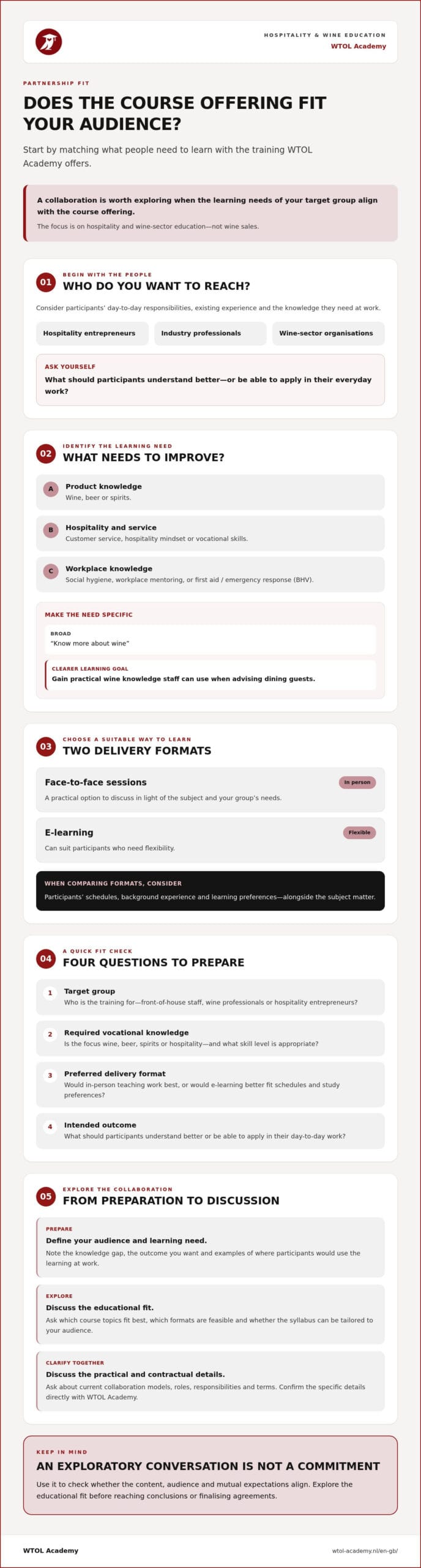
First, test whether the training programmes align with what your target group wants to learn. Consider the daily responsibilities of the participants and the knowledge they need on the job. For instance, a team that wants to advise guests confidently on wine has very different learning requirements from staff who need up-to-date knowledge on legislation and hygiene. By defining these needs beforehand, you can have a far more targeted discussion about the educational fit. On the page about becoming a partner, you will find further details to help you orientate yourself.
What are the training needs of your target group?
Clearly map out which knowledge or practical skills are missing in everyday operations. A hospitality team might, for example, require deeper knowledge of wine, beer, or spirits. Another organisation may wish to strengthen customer service, hospitality mindset, or vocational skills. The curriculum includes programmes such as social hygiene, workplace mentoring, and first aid / emergency response (BHV). Because these represent distinct learning pathways, evaluate which topic best addresses the people you wish to reach.
WTOL Academy delivers courses via face-to-face sessions and flexible e-learning. When choosing a delivery format, take into account the schedules, background experience, and learning preferences of your audience. E-learning is ideal for participants who require flexibility, whilst in-person training is another practical option to discuss. Review the course overview and note which subjects meet your educational objectives. This approach enables you to enter the initial conversation with a clear view of the educational alignment, without making premature assumptions about partnership criteria or terms.
Does the course offering suit your organisation? Ask these questions
A suitable course should not only sound appealing; it must genuinely suit the participants and their learning outcomes. Compare the requirements of your organisation with what your learners want to gain and how they prefer to study. Use this checklist to prepare:
- Target group: who is the training designed for, e.g. front-of-house staff, wine professionals, or hospitality entrepreneurs?
- Required vocational knowledge: does it focus on wine, beer, spirits, or hospitality, and what skill level is appropriate?
- Preferred delivery format: would in-person teaching be more effective, or does e-learning fit their schedules and study preferences better?
- Intended outcome: what should participants understand better or be capable of applying in their day-to-day work upon completion?
Formulate your learning goals as specifically as possible. Saying you want staff to "know more about wine" is broad; "acquiring practical wine knowledge that staff can use when advising dining guests" provides tangible direction. WTOL Academy offers both classroom-based tuition and e-learning. The most suitable format depends entirely on your group and the subject matter. View the courses and note down which ones match your objectives.
How to prepare for an initial exploratory discussion
Draft a brief summary of who you want to train, the specific knowledge gap you have identified, and what you aim to achieve through the training programme. Include practical examples of workplace situations where participants will apply this knowledge. This allows you to ask targeted questions: which course topics are the best fit, which formats are feasible, and how can the syllabus be tailored to your audience?
Discuss any questions you need answered before making a decision. Inquire about current partnership models and how roles and contractual terms are formalised. Never assume a rigid structure or agree to points that have not yet been evaluated together. Allow WTOL Academy to confirm the specific details directly with you. You can find further orientation on the page about becoming a partner, but ensure you discuss all possibilities personally.
How to explore the collaboration and determine the next step
An exploratory conversation does not need to result in immediate commitments. Use it as an opportunity to see whether the content, audience, and mutual expectations correspond. Follow these three steps:
- Define your target group. Detail who you want to reach and which skills or career development pathways are relevant to them.
- Discuss the training match. Present your learning aims and ask which course topics and study formats are most suitable.
- Confirm agreements. Summarise what you have discussed and agree upon the course selection, responsibilities, and conditions directly with WTOL Academy.
This prevents you from relying on assumptions about a partnership model that has not been discussed or may not be available. The arrangements often depend on your bespoke requirements. Treat the points below as topics for conversation rather than fixed prerequisites.
Which agreements should you confirm first?
Establish clearly which target group the partnership addresses, which subject sits at the centre, and which course format is being considered. Next, agree on who holds responsibility for each aspect and how you will communicate with participants or students. Furthermore, clarify which collaboration arrangements and commercial terms currently apply. Avoid drawing firm conclusions until WTOL Academy has verified these details.
Would you like to explore the background further? Read more about the possibilities on the page about becoming a partner with WTOL Academy. Then, take a look at the course offering from WTOL Academy to identify the topics you wish to explore during your consultation.
Explore a partnership with a clear starting point
A partnership with WTOL Academy starts with determining whether your target audience will benefit from the educational catalogue. First identify the required vocational knowledge, suitable study method, and desired learning outcomes. Then, discuss which training programmes align and establish together which responsibilities, communication channels, and conditions will apply. This ensures your decision is grounded in quality content and clear agreements rather than assumptions.
WTOL Academy was established in 2014 and delivers SVH-accredited courses for the hospitality and wine industry. The programmes are available through in-person teaching as well as online e-learning. Would you like to delve deeper into the opportunities for partnership? Explore the information on becoming a partner and discuss specific collaboration models directly with WTOL Academy.
Explore the opportunities to become a partner and discuss which courses best suit your audience.
Frequently asked questions about becoming a partner
What does becoming a partner with WTOL Academy involve?
Becoming a partner begins with exploring whether your target audience matches the course portfolio. This comprises training in wine, beer, spirits, and hospitality, alongside SVH Social Hygiene, SVH Workplace Mentor (Leermeester), and emergency response (BHV). Do not presume there is a one-size-fits-all framework. Discuss the current options and arrangements directly with WTOL Academy. You can find more information at https://wtol-academy.nl/partner-worden/.
Which organisations can WTOL Academy partner with?
Hospitality business owners, industry professionals, and organisations across the hospitality and wine sectors are ideal discussion partners. Do not assume there are rigid entry criteria. Whether a partnership is appropriate depends primarily on the audience you wish to train and the educational needs you identify. Allow WTOL Academy to confirm the concrete options with you directly.
How do you start a partnership with an educational institute?
Start with a brief outline of your target group and what they need to learn. Next, discuss which courses and study formats may provide a good fit. WTOL Academy offers both classroom instruction and online e-learning. Then, inquire about the roles, responsibilities, and conditions that apply to a prospective collaboration and have these confirmed directly. In doing so, you can assess the substantive match without mistaking unconfirmed details for established facts.
Which training programmes does WTOL Academy offer prospective partners?
The syllabus includes SVH Wine 1, 2, and 3, SVH Beer 1 & 2, SVH Spirits 1 & 2, and dedicated hospitality programmes. Other examples include SVH Social Hygiene, SVH Workplace Mentor (Leermeester), and emergency response (BHV). Which topics are most appropriate will depend entirely on your target audience and objectives. Compare the options in the current WTOL Academy course directory.