


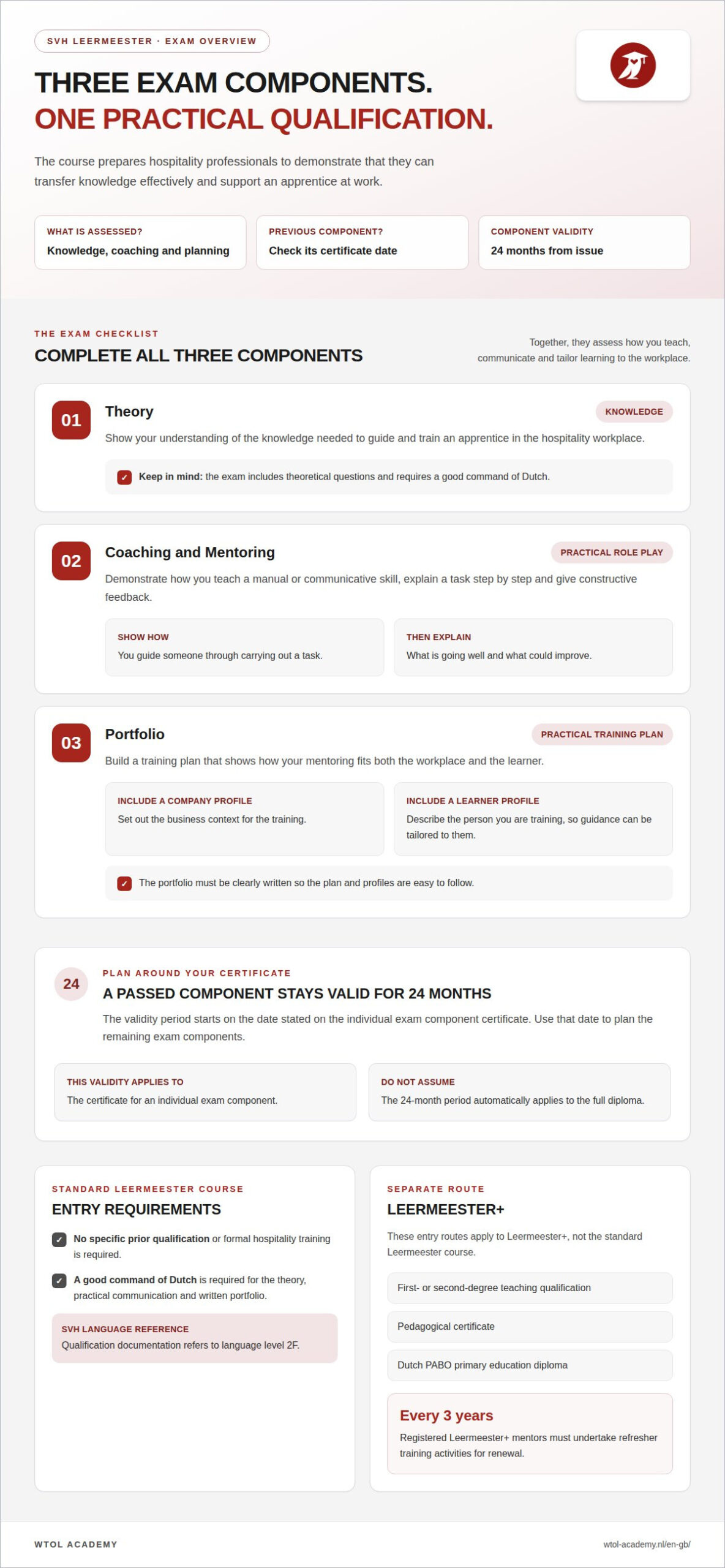
A previously passed examination component can still count: the certificate is valid for 24 months from the date issued. The Leermeester course prepares you for the three examination components: theory, Coaching and Mentoring, and the portfolio. If you have already completed one component, the validity date helps you determine how to plan the rest of your exams.
The Leermeester course at WTOL Academy is designed for hospitality professionals who want to mentor apprentices or staff members. You will discover what the qualification entails, who the training is suitable for, and which entry requirements apply. You will also learn how a previously completed exam component can affect your next steps, allowing you to use your experience to develop further as a qualified workplace mentor.
Key Takeaways
- You do not need any specific prior qualifications to start the course; a sufficient command of Dutch is required for the exam.
- With the diploma, you demonstrate that you can mentor and train apprentices within the hospitality industry.
- The portfolio centres on a practical training plan with profiles of both the business and the apprentice.
- Subject-specific expertise is essential, but instructional and communication skills also help you guide learners effectively.
SVH Leermeester Diploma
With the SVH Leermeester Diploma, you demonstrate that you can supervise and train apprentices in the hospitality industry. To earn the qualification, you must successfully complete three examination components: theory, the practical Coaching and Mentoring exam, and the portfolio. The SVH Leermeester Course prepares you thoroughly for all three. Together, these components assess whether you can transfer knowledge effectively and support an apprentice on the job.
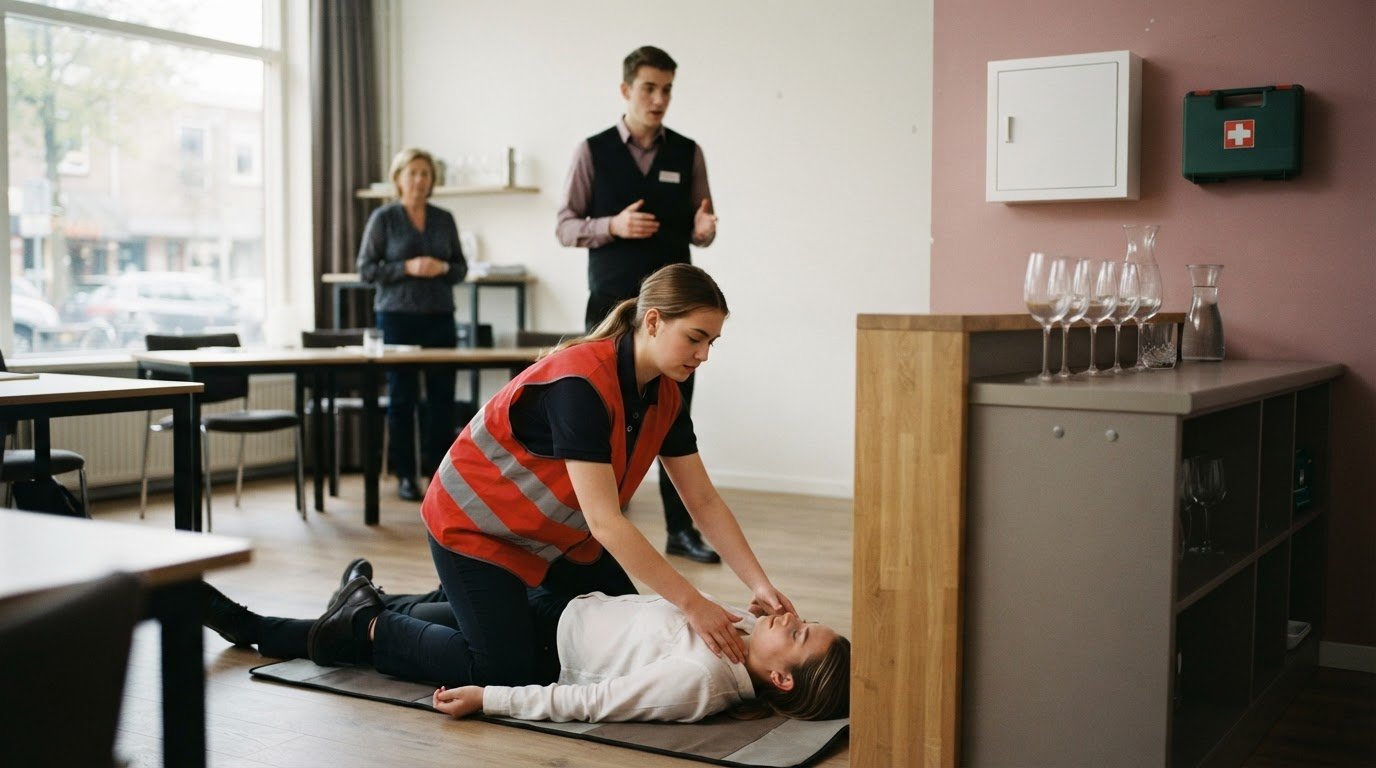
For the portfolio exam, you create a practical training plan featuring a company profile and a learner profile. This information helps you tailor your mentoring to the specific workplace and the person you are training. In Coaching and Mentoring, you take part in a role play to show how you teach a manual or communicative skill. For example, you might explain step-by-step how an employee carries out a task and then provide constructive feedback.
A Leermeester diploma is not the same as a standard Dutch MBO vocational diploma at level 2, 3, or 4. SVH Practical Certificates lead to SVH diplomas, rather than to those MBO qualifications. To obtain an SVH industry diploma, a learner must attain all associated practical certificates. A complete set of certificates for a given role or position makes it possible to apply for the corresponding industry diploma. As a mentor, you can guide staff through developing their skills and help them secure those credentials.
An SVH certificate awarded for an individual examination component remains valid for 24 months from the date stated on the certificate. This time frame applies specifically to the exam component, not automatically to the full diploma. For Leermeester+, a separate registration applies: registered mentors must undertake refresher training activities every 3 years for renewal. Targeted preparation for the SVH Leermeester exam helps you tackle each examination component and the required skills with confidence.
Target Group for the SVH Hospitality Leermeester Course
This course is ideal for hospitality professionals who want to mentor apprentices on the work floor. Think of an experienced chef teaching an apprentice how to prep, collaborate, and work with precision. Team members who induct new colleagues can also benefit greatly from instructional techniques. You do not just rely on your trade knowledge; you also learn how to pass it on step-by-step.
Anyone supervising apprentices in an accredited hospitality training company requires a Leermeester diploma. Specialist knowledge alone is not enough: strong communication skills help you adapt your guidance to what a learner can already do. For instance, a beginner benefits most from demonstration and repetition, whilst an advanced apprentice needs focused feedback. Effective mentoring therefore takes both the task and the individual into account.
The role of a workplace mentor can extend well beyond giving instructions during a shift. You can also recruit, select, introduce, and induct new team members. With a new colleague, mentoring begins with an introduction and an explanation of how the team collaborates. This is followed by day-to-day duties and feedback on what is going well or requires further attention. In this way, you connect learning directly and purposefully with workplace practice.
The training is especially valuable if mentoring is becoming a regular part of your job, or if you will soon be taking on an apprentice. You will build the skills needed to convey knowledge clearly and support learners throughout their development. If you also want to broaden your expertise across other areas of the trade, explore our range of hospitality courses to see which pathway best matches your ambitions.
What Entry Requirements Apply to the SVH Leermeester Course?
No prior qualifications are required for the SVH Leermeester Course. You do not need a specific diploma or previous formal hospitality training to enrol. The course focuses squarely on the knowledge and practical skills required for the Leermeester exam: understanding theory, mentoring a learner, and substantiating your approach within a portfolio. Even if your experience comes purely from hands-on work, you can prepare thoroughly for the exam requirements.
A good command of Dutch is required for the SVH Leermeester exam. You will face theoretical questions and must communicate clearly during the Coaching and Mentoring practical. The portfolio also demands well-formulated writing to ensure your training plan and profiles are easy to follow. In its qualification documentation, SVH references language level 2F, providing clear context regarding the language proficiency expected for the exam.
Please note the distinction between the standard mentor training and Leermeester+. Teachers holding a first- or second-degree teaching qualification, a pedagogical certificate, or a Dutch PABO primary education diploma qualify for Leermeester+. These are specific entry routes for Leermeester+, not for the standard course. If you have already completed an exam component in the past, that could be relevant to your exam schedule. The validity period is clearly marked on your component certificate.
When preparing, start by mapping out the experience you already have in demonstrating tasks and giving feedback. This helps you identify which skills you want to refine alongside the theory. Explore the courses and choose your next step towards becoming a qualified mentor.
WTOL Academy: SVH Leermeester
WTOL Academy provides the SVH Leermeester training course for hospitality professionals looking to mentor apprentices and prepare for their diploma. Now that you know which exam components and entry requirements matter, you can decide how to apply mentoring in your daily work and which areas of expertise to develop next.
Looking to broaden your professional knowledge alongside mentoring? WTOL Academy also offers SVH Beer 1 & 2, SVH Spirits 1 & 2, and SVH Social Hygiene. This allows you to choose training that aligns perfectly with your hospitality role and career goals.
Get in touch with WTOL Academy to discuss which programme best suits your next step.
Continue Your Development in the Workplace
Stepping into a mentoring role can also be the springboard for broader professional development within hospitality. Consider the specialist knowledge that would help you guide colleagues and apprentices with even greater insight. If you would like to deepen your wine knowledge, for instance, you can choose from SVH Wine 1, SVH Wine 2, and SVH Wine 3 (Wine Certificate). That way, you can steer your professional growth in a direction that reflects your interests and daily responsibilities.
An SVH Leermeester course is a purposeful move if you want to use your practical experience to help others flourish. Take a look at which training programmes match your next learning goal. By making a considered choice, you will link new expertise directly to your workplace and continue strengthening your role in the team.
Discover the courses at WTOL Academy and select the right path for you. Every new skill contributes to a stronger, more capable hospitality business.
Frequently Asked Questions
I have previously passed one of the three Leermeester exam components; what should I do now?
You can carry that component over as long as the SVH certificate remains valid. Validity lasts for 24 months from the date printed on the certificate. Check that date carefully and schedule your remaining exam components within that timeframe. Keep your certificate safe so you know exactly which component you completed and when as you plan your exams.
Need more information?
Get in touch with WTOL Academy if you have any questions about the course or your individual situation. If your question relates to a previously passed exam component, have your exam date and SVH certificate details to hand. This ensures we can address your query specifically and help you choose the best next step for your learning goals.
What is the SVH Leermeester course and who is it intended for?
The SVH Leermeester course prepares you for the exam that certifies your skills as a workplace mentor. The course is suited to hospitality professionals looking to coach apprentices or colleagues. No specific prior education is required. If you frequently show new team members the ropes during shifts, this training supports you in stepping into an accredited mentoring role.
What should you look for when choosing an accredited training provider for the SVH Leermeester course?
Make sure your preparation covers all examination components: theory, Coaching and Mentoring, and the portfolio. Check how the exam day is organised and verify whether any previously completed component can still count towards your diploma. WTOL Academy offers the SVH Leermeester course to prepare you thoroughly for your role as a workplace mentor in hospitality.
What duties and responsibilities does an SVH Leermeester have in a hospitality business?
An SVH Leermeester guides apprentices as they learn on the job in daily hospitality operations. You demonstrate tasks, give learners the chance to practise, and offer constructive feedback. You can also handle inductions and onboarding for new staff. By adapting your guidance to each person’s current abilities, you ensure your mentoring directly supports their daily responsibilities.