

What if the difference between a thriving business full of young talent and a chronic staff shortage simply came down to one specific certificate? Many hospitality entrepreneurs wonder when an SVH Mentor in Hospitality is mandatory, especially now that the rules surrounding SBB accreditation will be more strictly enforced in 2026. It’s understandable that there is confusion; the line between social Responsibility and professional practical supervision is often blurred, whilst the fear of fines for incorrect supervision is real. After all, you not only want to comply with the law but also offer an inspiring environment where genuine craftsmanship can flourish.
In this complete guide, you will discover exactly when the law requires a qualified mentor and how to expertly prepare your hospitality business for the arrival of eager students. We will remove the complexity of SBB accreditation and provide you with a clear step-by-step plan to become an officially accredited training company. From understanding the latest examination requirements to the benefits of the new SVH Master Trainer+ diploma: after reading this, you will know exactly how to use mastery for the growth of your team and the future of your business.
Key Points
- You will discover exactly when an SVH Master Trainer is mandatory for your hospitality business and what role the SBB plays in this when employing MBO students.
- Gain clarity on the crucial difference between social responsibility and master trainership, so you always meet the correct legal requirements.
- Learn how to transform your business into an accredited training company and what benefits this offers for the growth and reputation of your team.
- Understand the structure of the official examination, from compiling a portfolio to mastering the coaching and theory components.
- Discover how a modern combination of e-learning and practical training prepares you for successful certification and quality supervision.
Table of Contents
The Path to an Accredited Training Company and the Role of SBB
The Difference Between Social Responsibility and the SVH Master Trainer
How Do You Become an SVH Master Trainer? The 2026 Step-by-Step Plan
When is an SVH Master Trainer Mandatory in Hospitality?
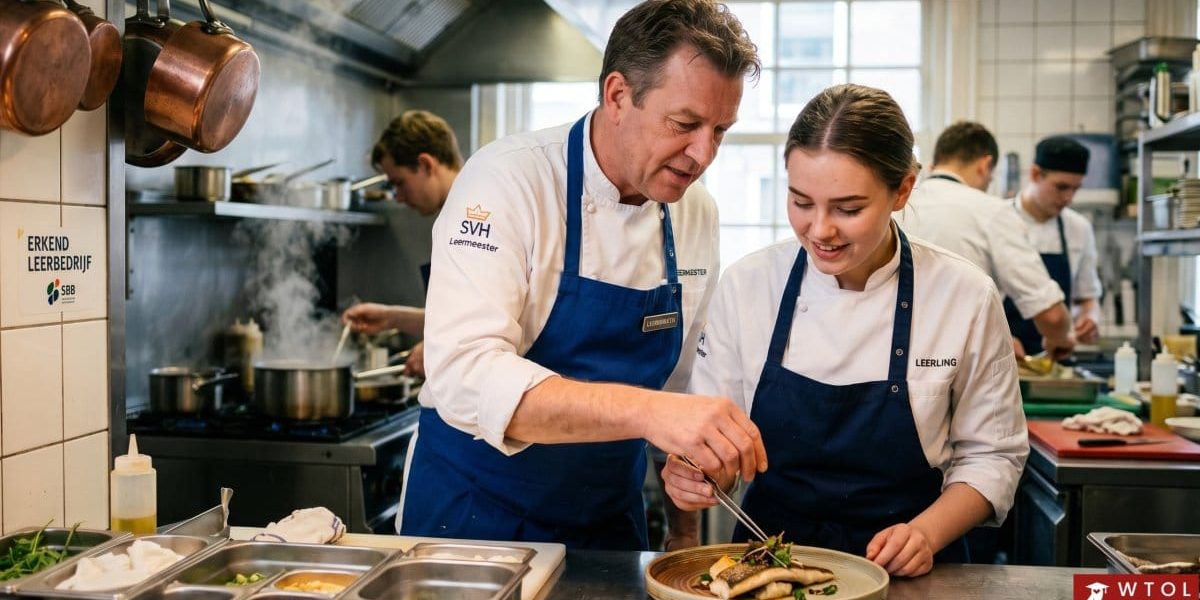
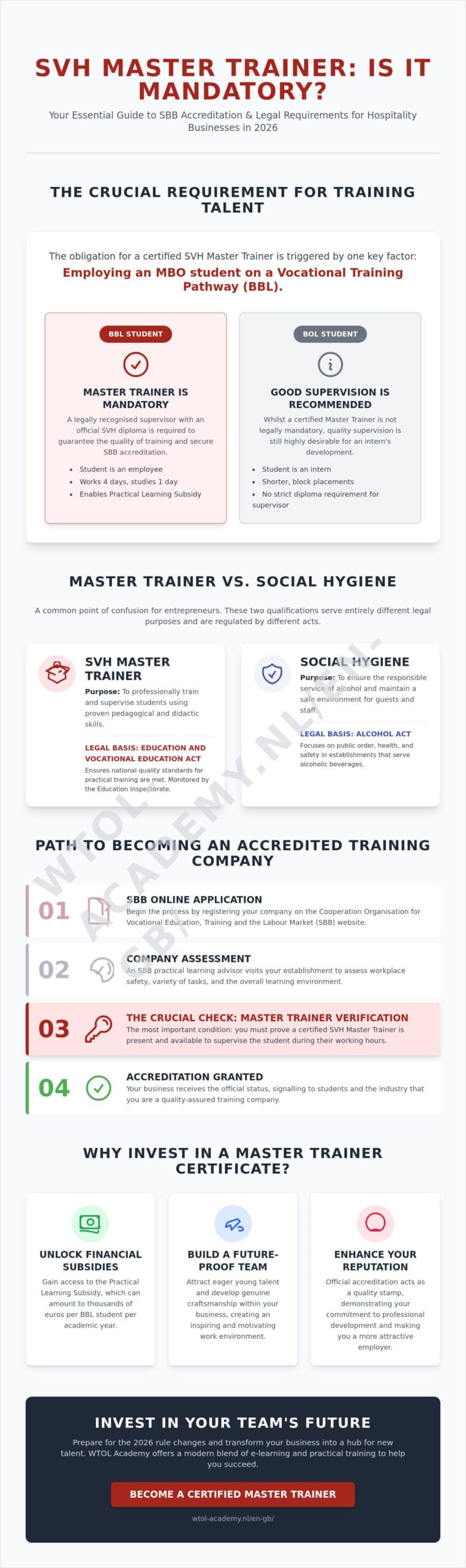
The answer to the question of when an SVH Master Trainer is mandatory is closely linked to your ambitions as an entrepreneur and the composition of your team. An SVH Master Trainer is much more than an experienced professional on the shop floor; it is a legally recognised practical supervisor who possesses the pedagogical and didactic skills to shape aspiring talent. Essentially, this role becomes mandatory the moment you enter into an official training agreement with a student undertaking a practice-oriented course.
The main trigger for this obligation is the employment of MBO students following the vocational training pathway (BBL). In a BBL programme, the student is effectively an employee who works in your business four days a week and attends school one day a week. Without a qualified master trainer, you simply cannot train these students. This differs from the vocational education pathway (BOL), where an intern participates for shorter periods. Whilst good supervision is also desirable there, for BBL programmes, the law imposes strict requirements on the certification of the supervisor to guarantee the quality of craftsmanship.
Scenarios where a Master Trainer is Indispensable
If you want to benefit from the practical learning subsidy in 2026, a certified master trainer is an absolute prerequisite. This subsidy is a contribution towards the costs you incur for supervising a BBL student and can amount to thousands of euros per academic year. A "regular" experienced employee is not sufficient here; the SBB (Cooperation Organisation for Vocational Education, Training and the Labour Market) strictly checks whether the supervisor actually holds the SVH diploma. Without this proof of competence, your hospitality business will not receive accreditation as a training company, and your right to financial support will lapse.
The Legal Basis in Education Regulations
A common misconception is that the obligation stems from the Alcohol Act. This is incorrect; the Alcohol Act regulates social hygiene, whilst the master trainer obligation is enshrined in the Education and Vocational Education Act. The Education Inspectorate closely monitors that practical supervision meets national quality standards. Experience alone is not legally valid in the eyes of the law. A diploma proves that you not only know how to cook a perfect steak or present a wine but also how to transfer that knowledge in a way that motivates and develops the student. For entrepreneurs who are serious about their personnel policy, obtaining this certificate is therefore the only way to a future-proof business.
The Path to an Accredited Training Company and the Role of SBB
To be allowed to train MBO students, your business must be registered as an accredited training company. This is where the Cooperation Organisation for Vocational Education, Training and the Labour Market (SBB) comes in. The SBB is the statutory body that oversees the quality of practical training courses in the Netherlands. They work closely with the SVH to ensure that the theory from textbooks seamlessly connects with the dynamic reality of the hospitality floor. When an SVH Master Trainer is mandatory is directly related to this accreditation: without a qualified mentor in your team, you simply will not receive approval from the SBB.
The master trainer acts as the indispensable link between the educational institution and your company. It is not enough to simply have a diploma hanging on the wall; the law states that the master trainer must actually be present during the hours the student is working. As a mentor, you are the guide who helps the student master complex tasks and sharpen the professional attitude that makes our sector so unique. The SVH Master Trainer Diploma is proof that you possess the right coaching techniques to lead this process.
How Do You Obtain SBB Accreditation?
The process begins with an online application to the SBB. After your registration, a practical learning advisor will visit to assess your company. They will check whether the workplace is safe and whether you can offer sufficiently varied work that matches the student’s course. The most important condition is the link between your staff and the SBB registration. Only when you can demonstrate that a certified supervisor is present on the shop floor will the status of accredited training company be definitively granted. This process provides a quality stamp that also shows potential new employees that your business invests in growth.
Fiscal Benefits of a Qualified Master Trainer
In addition to the qualitative growth of your team, having a master trainer offers significant financial benefits. Through the practical learning subsidy scheme, you can apply for a contribution towards supervision hours in 2026. Whilst the exact amounts may vary annually, it often involves a substantial amount per student that more than covers the costs of the training. Many entrepreneurs find that the investment in professional training pays for itself within the first year, especially when you factor in the increased productivity of a well-trained student. Are you ready to take this step? Then view our range of accredited hospitality training courses to take your team to a higher level.
The Difference Between Social Resonsibility and the SVH Master Trainer
In the daily hustle and bustle of a hospitality business, certificates and diplomas are often lumped together. A common misconception is that a manager with a social hygiene diploma is automatically authorised to supervise students. Nothing could be further from the truth. Whilst both diplomas are essential for professional business operations, they serve entirely different purposes. Social hygiene focuses purely on the Alcohol Act and the safety of your guests, whilst the master trainer focuses on pedagogy and the transfer of the craft to the next generation.
Confusion often arises because both diplomas are issued by the SVH and both can be mandatory within one organisation. However, the risk of this misunderstanding is significant. Entrepreneurs who believe they are correctly supervising their MBO students without the proper qualifications not only risk fines but also the revocation of their training status. The official SBB Regulation for the Recognition of Training Companies is uncompromising in this: proving craftsmanship is one thing, transferring it according to the rules is another.
When Do You Need Which Diploma?
The dividing line can actually be drawn very simply based on the applicable legislation. Do you have a hospitality licence? Then the Alcohol Act stipulates that someone with a social hygiene qualification must always be present when alcohol is served. This is a strict requirement for your licence. The question of when an SVH Master Trainer is mandatory only arises with education regulations. As soon as an MBO student comes to learn the trade from you, the law requires a qualified practical supervisor. Do you want to know more about the basics? Then read all about the social responsibility obligations and how they protect your business.
Can You Become a Master Trainer Without Social Responsibility?
Technically, there are no strict admission requirements stating that you must first have social hygiene before starting the master trainer course. Nevertheless, WTOL Academy advises securing both diplomas within your management team. There is a strong synergy between hospitality and education. A good mentor not only understands how to coach a student but also knows how to teach that same student the intricacies of responsible hospitality. By combining both qualities, you create a safe learning environment where quality and legal frameworks go hand in hand. It strengthens your position as an employer and makes your business more attractive to ambitious talent looking for true masters of the trade.
How Do You Become an SVH Master Trainer? The 2026 Step-by-Step Plan
Understanding when an SVH Master Trainer is mandatory is the first step towards becoming an accredited training company. The next phase is actually completing the certification process. In 2026, this process is more accessible than ever, provided you choose a structured approach. Obtaining your diploma begins with selecting an accredited training provider that bridges the gap between theoretical frameworks and daily practice in the kitchen or service. WTOL Academy offers a proven method for this, with a focus on a high success rate, which for top providers is between 88% and 96%.
Once you start preparing, you work towards the official SVH examination. This examination is an independent assessment of your competence and has a fixed structure. Factor in a national examination fee, which in 2026 will be approximately between €310 and €325. After successfully completing the three core components, your diploma will be registered, after which you are officially authorised to supervise students and apply for the associated subsidies. Do you want to get started immediately with a course that perfectly fits your busy schedule? Then view the SVH Master Trainer course and take the first step.
What Do You Learn During the Course?
A good master trainer is a mentor who responds to the needs of the current generation of students. During the training, you learn how to coach young people and career changers in an inspiring way. It’s not just about transferring skills but also about assessing vocational skills according to official MBO standards. In addition, you develop skills in recruitment and selection. You learn how to make the right match between a student and your business, so that the collaboration is a success for both parties.
The Three Components of the SVH Examination
The official examination is structured around three essential components that together prove your professional competence. The theory examination tests your knowledge of education legislation, didactics, and regulations surrounding practical learning. In the practical examination, you conduct a coaching conversation with a student, where the examiner looks at your communication techniques and your ability to give constructive feedback. Finally, you compile a portfolio. This is a collection of evidence of your own skills as a mentor, in which you demonstrate that you can create a learning environment that meets all national quality requirements.
Invest in Your Team’s Future with WTOL Academy
Now that you know exactly when an SVH Master Trainer is mandatory, it’s time to translate this into practice. Obtaining this diploma is not a bureaucratic hurdle but an investment in the quality of your staff. At WTOL Academy, we understand that the hospitality industry never stands still. That’s why we have developed a learning pathway that seamlessly connects with the dynamics of your business. Our approach combines the depth of classic master-mentor relationships with the efficiency of modern technology.
The results speak for themselves. Participants in our training courses achieve a remarkably high success rate, ranging between 88% and 96%. This success stems from our unique blend of interactive e-learning and physical practical days. You prepare the theory in your own time, so that during the meetings we can delve directly into role-playing and coaching techniques. This flexibility is essential for entrepreneurs and managers who run the business during the day and want to enhance their own competence in the evenings. Curious about the possibilities? View our full range of SVH courses and discover which training suits your ambitions.
Why Choose WTOL Academy?
Our trainers come directly from practice. They speak the language of the shop floor and know exactly what challenges you face when supervising young MBO students. We offer personal support in building your examination portfolio, a component that many trainees find difficult. Through our targeted feedback, you will enter the examination with a strong dossier and full confidence. In addition, we are happy to help you with financing. There are often various training budgets and subsidies available that significantly lower the threshold for professionalisation.
Ready to Take the Next Step?
A qualified master trainer in your team fosters a culture of continuous improvement. It attracts ambitious students who know that they can complete an officially accredited programme with you. In modern hospitality, standing still is going backwards; continuous education is the key to lower turnover and higher hospitality. Would you prefer us to work with the entire team? For larger groups, we provide customised in-company training, where we directly link the course material to your specific business formula and house rules. Contact us today to accelerate your team’s growth.
Build a Future-Proof Team with Certified Mastery
It is clear that professional mastery forms the basis for a thriving hospitality business. You now have a clear picture of when an SVH Master Trainer is mandatory: as soon as you opt for the growth of your team through official MBO programmes and wish to utilise the associated fiscal benefits. The sharp distinction between social hygiene and professional practical supervision is crucial here to prevent fines and truly guarantee quality on the shop floor.
As an SVH accredited training institute, WTOL Academy supports you every step of this process. We combine flexible e-learning with inspiring practical training, resulting in the highest success rates in the Netherlands. This way, you prepare yourself or your employees optimally for the examination without disrupting daily operations. You not only learn the rules but also develop the skills to be a true mentor for the new generation.
**View our SVH Master Trainer course and start immediately **
Seize this opportunity to pass on your passion for the profession and elevate your business to a higher level. We look forward to welcoming you as the next master-mentor in the sector. Good luck with the preparation!
Frequently Asked Questions About the SVH Master Trainer
Is an SVH Master Trainer mandatory for every intern in hospitality?
No, a qualified master trainer is not a strict requirement for every type of internship, but it is mandatory as soon as you want to supervise MBO students from an accredited vocational course. For taster internships or short social internships, less stringent rules apply. However, to be officially registered as an accredited training company with the SBB, at least one employee with an SVH diploma must be present to guarantee the quality of education on the shop floor.
How many students can one qualified master trainer supervise at the same time?
There is no legally defined maximum number of students per master trainer, but the SBB advises a healthy balance to guarantee the quality of supervision. In practice, we often see one mentor intensively supervising one to two BBL students. The practical learning advisor from the SBB assesses during the company scan whether the master trainer has sufficient time and space to give each student the attention needed for their personal growth.
What are the consequences if I supervise MBO students without an SVH diploma?
Supervising MBO students without the correct qualifications can lead to the immediate revocation of your status as an accredited training company. This is precisely when an SVH Master Trainer is mandatory; without this diploma, the training agreement is not legally valid. Moreover, you miss out on the practical learning subsidy scheme, and a school may decide to immediately remove the student from your business because the quality of education cannot be guaranteed.
Is the SVH Master Trainer diploma valid indefinitely or do I need to renew it?
The official SVH diploma for master trainers is valid indefinitely and does not need to be renewed periodically. Once obtained, you retain the legal authority to supervise students. However, many professionals in 2026 opt for additional training, such as the new SVH Master Trainer+ diploma. This not only allows you to coach but also to officially sign off on practical evidence, which makes your role within internal company training even more valuable.
Can I get a subsidy for the costs of the master trainer course?
Yes, there are various possibilities to cover or reduce the costs of a master trainer course. In addition to the practical learning subsidy scheme, which offers a contribution towards supervision hours, there are often sector-specific funds or the SLIM subsidy for SME entrepreneurs. It is always worthwhile to check in advance which current funds are available in 2026 for the professionalisation of your hospitality team.
What is the difference between a mentor and a master trainer in hospitality?
The difference lies in official accreditation and assessed skills. A mentor is often an experienced colleague who informally gives tips on the shop floor without a diploma to back it up. A master trainer is a certified professional who has passed an official SVH examination. This person possesses proven pedagogical and didactic qualities to systematically train students according to national MBO qualification files.
Must the master trainer always be physically present on the shop floor?
Yes, the SBB requires that the qualified master trainer must be present during the hours the student works in the business. The essence of practical learning is, after all, direct coaching and guidance on the shop floor. If the main responsible master trainer is not present, another qualified supervisor must be on standby. This ensures a safe learning environment where the student can rely on expert advice at any time.
How long does it take on average to obtain the SVH Master Trainer diploma?
Most trainees obtain their diploma within a few weeks to months, depending on the chosen study format. An intensive preparatory course often lasts three days, combined with self-study via e-learning. The focus here is on building your portfolio and training coaching skills. With an average success rate of between 88% and 96%, the programme with a good training provider can be completed very efficiently and purposefully.